Low-CarbonIndustry News
Zigbee vs BLE Mesh vs WiFi for Retail Lighting Retrofit
Introduction
This zigbee vs ble mesh vs wifi for retail lighting retrofit guide compares the three protocols on the four lines that decide a live-store refit: node capacity, latency, offline control, and what the crew carries on day one. The short version: WiFi suits a handful of fittings, Zigbee suits centrally managed estates, and BLE mesh suits running stores — a phone groups a zone from the sales floor while trading continues below. The BLE column below follows our BLE mesh setup for live-store refits.
- Zigbee — routed mesh, gateway-managed, built for centrally run estates.
- BLE mesh — flooding mesh, phone-direct, built for fast live-store refits.
- WiFi — star topology on the shop router, fine for a handful of fittings.

The Three Protocols in One Table
Read the table row by row against your own floor plan: a 500-fitting mall and a 12-fitting boutique punish different weaknesses. Figures are public specification and lab-test values, quoted conservatively.
| Line | Zigbee 3.0 | BLE mesh | WiFi |
|---|---|---|---|
| Radio basis | IEEE 802.15.4, 2.4 GHz | Bluetooth Low Energy, 2.4 GHz | 802.11 on the shop router |
| Air rate | 250 kbps | Up to 1 Mbps on BLE 5 bearers | High, shared with shop traffic |
| Mesh style | Routed, via coordinator | Managed flooding, no coordinator | Star — every head needs the router |
| Network size | 65,000 theoretical addresses | 32,000 theoretical, 4000-node commercial practice | About 30 devices per consumer router |
| Scene latency | Typically 50-100 ms per command path | Typically 10-30 ms on short packets | Fast on empty air, jittery under load |
| Commissioning | Gateway plus software tools | Phone app, bulk zone profiles | Per-head app pairing to WiFi |
| Internet down | Local mesh keeps running | Local mesh keeps running | Cloud-paired heads usually stall |
| Best refit fit | Multi-site centrally managed estates | Running stores, phased rollouts | Single rooms under a dozen fittings |
One honest footnote on latency: independent lab tests show BLE mesh spreading toward 250 ms on large payloads across big unoptimized networks — which is why relay-node planning and short scene packets belong in the design, not in the marketing. Small lighting commands on a planned mesh stay in the 10-30 ms band above.
Why Retrofits Punish Two of Them
A retrofit is not a lab bench: ceilings stay closed, the store keeps trading, and the electrician counts every cable pull. WiFi fails first on scale — the router's device table fills first, and each head competes with tills, cameras and staff phones for the same airtime. Zigbee survives scale but bills gateway hours: a coordinator per network, software addressing per driver, and BMS-grade planning that suits new builds better than Sunday-night refits.
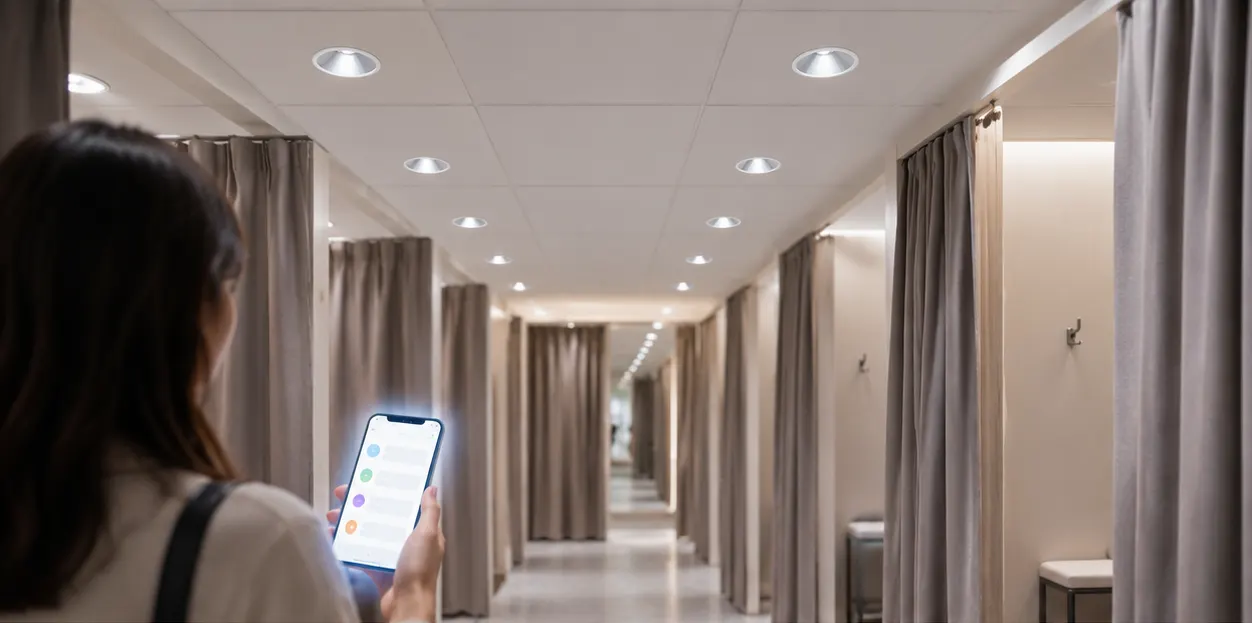
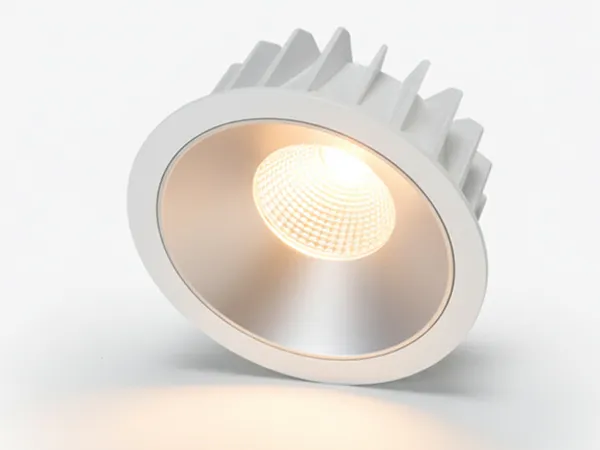
BLE mesh was drawn for exactly this corner: mains-only wiring between fittings, every head relaying for its neighbours, and zones regrouped in the app when the planogram changes. The DL01-BLE bluetooth mesh downlight for retail zones wires this way — no signal pair, scenes from phone or wall keys — so the comparison above is not theory on this site.

Teclux Verdict: The BLE Column, Honestly Priced
For a running retail refit, our money stays on the 4000-node mesh with phone setup: no coordinator hardware to buy per network, bulk profiles instead of per-driver addressing, and schedules that survive an internet outage. Zigbee keeps its crown where a facilities team centralises dozens of sites through gateways and a BMS — different job, different winner. WiFi keeps the single-room jobs where pulling any new wire at all would cost more than the fittings.
The proof on our shelf is the DL01-BLE at 10-30W and 1450-4300lm, UGR22 Ra90 with 38/60-degree beams in the same 105-200 mm cutouts as the wired family — one housing, two control worlds, and a gateway only where timers or remote branches need it. The site flow behind that verdict is written down in the bulk commissioning flow for BLE mesh lighting zones, and the money behind it in the wired DALI control wiring cost for live-store refits comparison.
FAQ
Conclusion
Count fittings first, then pick the column: dozens on one router can stay on WiFi, centrally managed estates earn their Zigbee gateways, and everything trading while it refits belongs on BLE mesh. Run the numbers on your own floor plan — the table above travels well to any quotation meeting. Once the protocol is settled, buy against the Bluetooth NLC interoperability checklist for retrofit buyers so the fittings stay open to other brands.
The split stays practical: Zigbee routes at 250 kbps through gateways, BLE mesh floods at up to 1 Mbps from a phone, and WiFi stalls near about 30 devices per consumer router. That is why running stores phase on the 4000-node BLE practice while centrally managed estates keep Zigbee.
Sources
- According to the Connectivity Standards Alliance, Zigbee full-stack solution (2026), Zigbee is a self-healing mesh built for commercial buildings.
- This page compares the three protocols on node capacity, latency, offline control, and day-one commissioning gear.
Contents Table
Send Message
Fill out the form and we will get back to you as soon as possible