Small-Space Lighting Control With a Matter DALI Panel and No Master
One bus per room — IR sensor-master or panel-plus-Matter
One Room, Two Routes, No Controller Cabinet
Our Matter DALI panel control for small spaces serves hotel guestrooms, homes and compact offices where hiring a programmer for a full-size controller makes no sense. This page covers DALI lighting without master controller hardware through two field-proven routes: sensor-led DALI group control where a ceiling unit takes master duty after an IR setup, and panel-plus-platform rooms where NFC setup prepares every driver with no host on site.
A compact converter feeds the bus and carries Matter commands while a wired scene panel keeps local hand control, so each room runs itself from day one.
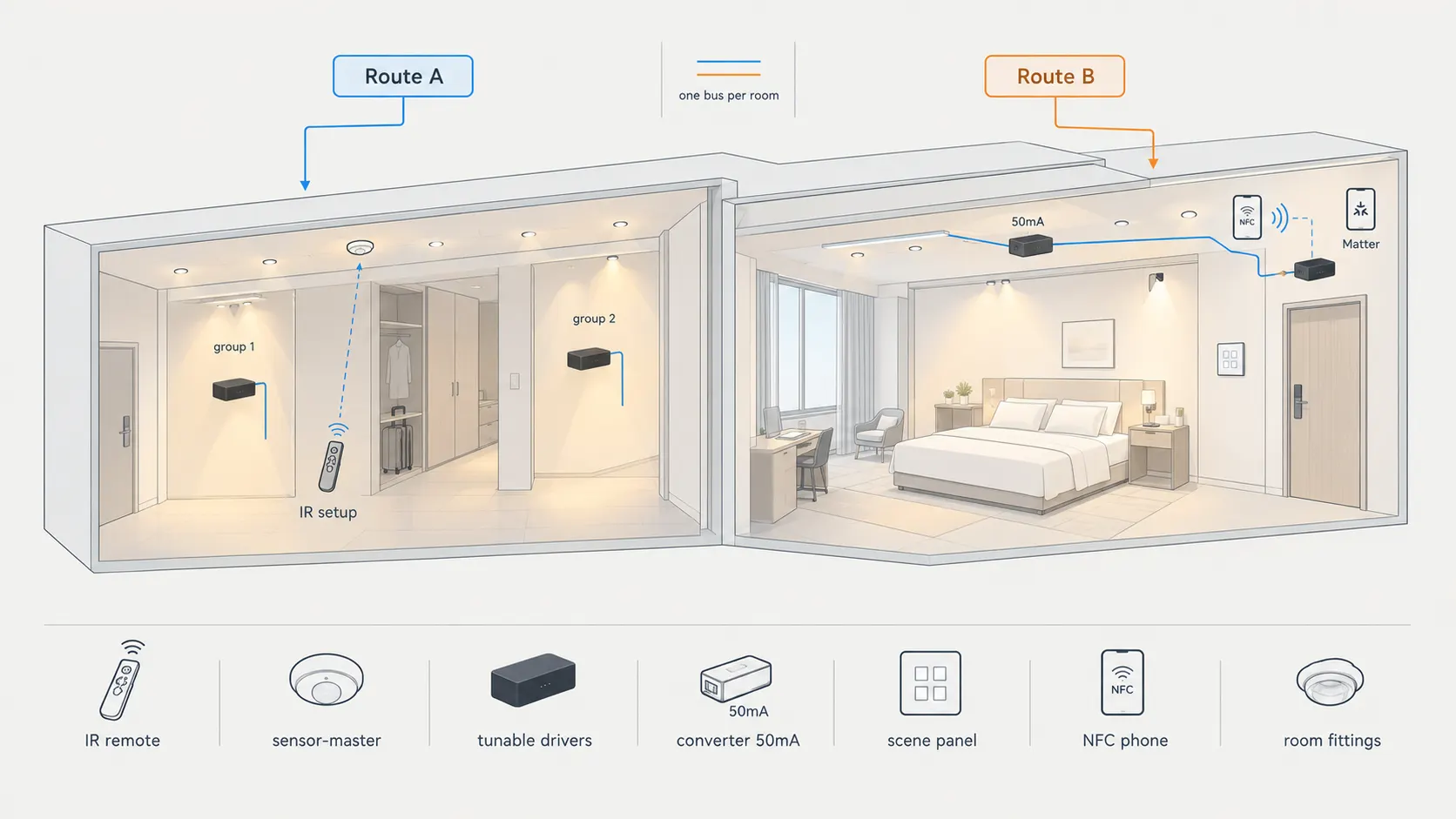
Route A: IR sensor masters its groups. Route B: converter plus panel share one bus — no master hardware.
How the No-Host Combination Works
One room, two routes, zero controller cabinet
Sensor Takes Master Duty
A handheld remote aims an infrared beam at the ceiling unit and assigns master-versus-slave roles plus group, address or broadcast scope. The chosen sensor then drives its DALI groups directly, pairing occupancy with daylight harvesting while drawing its own supply from the bus.
Panel Meets Matter
A compact converter supplies the bus and translates platform commands onto the same pair that a local DALI-2 scene panel uses. Guests keep on, off, dimming and scene recall at the wall; managers reach the same fittings from the Matter side.
Phone-Tap Commissioning
Every controller and driver on the panel route accepts its device type and output values from a phone tap before mounting or beside the ladder. No lighting host travels to site, and stored values survive power cuts without rework.
System Topology
Two routes into one small room
Infrared assigns sensor duty on the upper bus; phone taps prepare gear on the lower bus — both land in one room.
Each project belongs to exactly one route, never both at once. Sensor-led floors divide into two DALI groups behind a bus-mastering ceiling unit, with a dual-voltage driver pair covering 220–240V and 120–277V mains from the same automation. Panel-led rooms hang a converter, a scene panel and phone-tapped gear on a single short bus instead.
Our supply scope is the visible half — DL01-series and IRIS-series housings for guestrooms. Control gear follows openly numbered Sunricher sensor, converter, panel and driver parts, so spares stay sourced on the open market instead of locked to one fixture vendor.
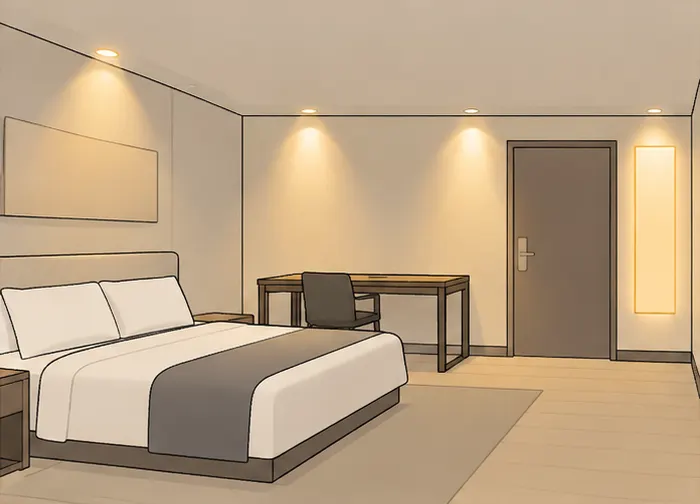
Scene: guestroom. One short bus serves bedside, desk and entry fittings with panel scenes plus platform access.
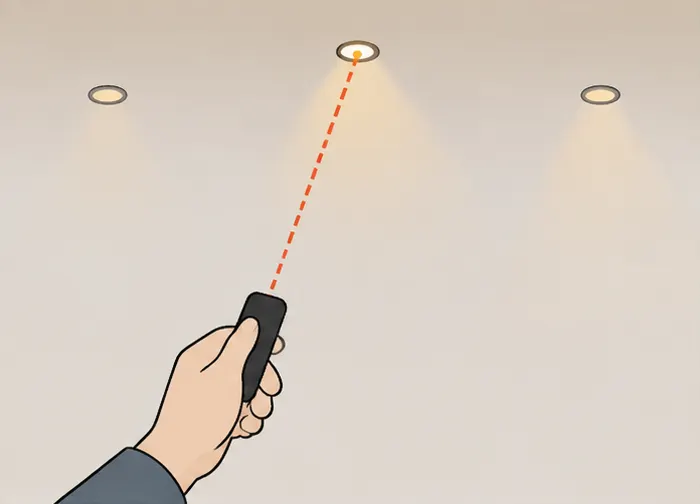
Setup: infrared. The remote assigns master duty, groups and addresses over a two-way beam from floor level.
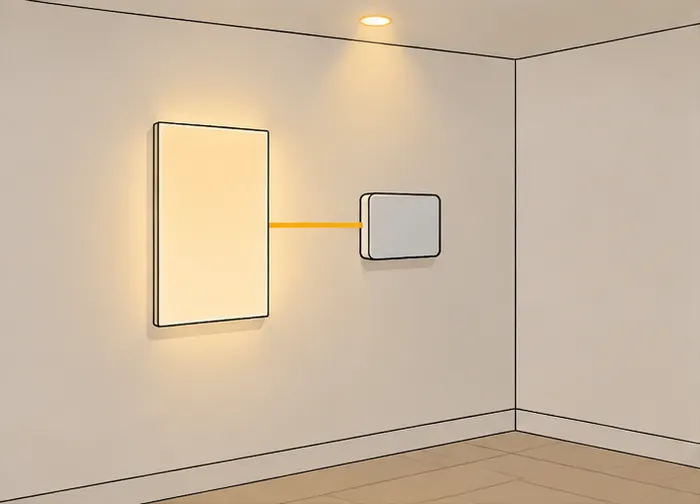
Pair: converter plus panel. The 50mA unit feeds the bus while wall presses and platform commands share it.
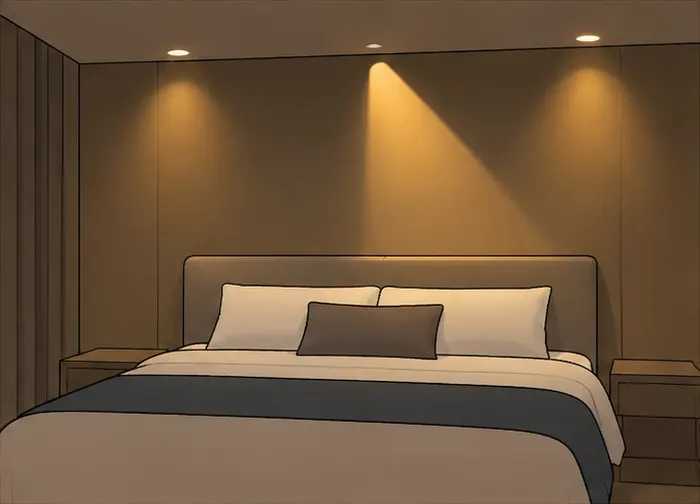
Fittings: room set. Recessed and tiltable heads divide general, bedside and wall-wash duty per datasheets.
What Goes Into One Small Project
Pick route A or route B per room, openly sourced gear
| Part | Role in this solution | Key facts | Supplied by |
|---|---|---|---|
| IR configuration remote | Route A setup tool | Two-way infrared link; assigns master-versus-slave roles plus group, address or broadcast scope from floor level | Sensor control gear |
| Ceiling PIR and daylight sensor | Route A bus master | Infrared receive plus transmit; bus-powered occupancy and daylight sensing; direct group, address or broadcast drive in master mode | Sensor control gear |
| 40W tunable-white drivers, pair | Route A group feeds | Two-channel tunable output at 500–1050mA; one D4i unit for 220–240V, one wide-voltage unit for 120–277V; grouped automation per zone | Sensor control gear |
| Matter-to-DALI converter, pick one of three | Route B bus supply and platform entry | Up to 50mA bus power plus Matter integration and wireless Touchlink; single-color, tunable-white or RGBWA variants per load | Panel control gear |
| Local DALI-2 scene panel | Route B hand control | On, off, dimming and scene recall at the wall; shares the same bus with the converter cooperatively | Panel control gear |
| Single, five-channel and two CC units | Route B load gear | Single-channel PWM, five-channel constant-voltage, 25W tunable-white at 250–700mA and 12W single-color at 100–700mA; all four accept NFC setup with no host | Panel control gear |
Model numbers follow the specialty cards for traceability and appear once on this page; the body text uses generic names. All drivers, converters and panels above are Sunricher control gear. Route A suits corridors, washrooms, storage and compact offices; route B suits homes, guestrooms and small retail. Below are Teclux housings for scene reference only — housing, beam and cutout per series sheet; project engine plus Sunricher gear per route, confirm variant sheet before ordering. Recessed tiltable housings for bedroom walls point to the recessed tiltable downlights for bedroom walls.
| Teclux housing (series) | Room | Light task | Gear match |
|---|---|---|---|
| DL01-series recessed housings | Guestroom ceilings and entries | Anti-glare general light with scene dimming | Project engine plus Sunricher driver per route, confirm variant sheet |
| IRIS-series tiltable recessed housings | Bedside and wardrobe walls | Aimed accent and reading light beside the bed | Project engine plus Sunricher driver per route, confirm variant sheet |
| IRIS-series surface housings | Concrete slabs with no cutout | Tiltable general light without ceiling surgery | Project engine plus Sunricher unit per route, confirm variant sheet |
- Assign each room to one route — sensor-led groups or panel-plus-platform, never a hybrid of both in one bus.
- Configure before power-up — infrared roles for route A, phone-tap values for route B, each stored inside its own device.
- Wire one short bus per room — converter or sensor feeds it; panel and gear share the same pair.
- Walk-test every input — remote, sensor, wall panel and platform each prove their path before handover.
Infrared Master Versus NFC Host-Free: Which Route
Core comparison plus sibling options
Small jobs usually hit the same three problems — a programmer day costs more than the room fittings, guests still want a normal wall switch, and managers still want phone access without running a server. A guestroom starting point that installers adjust on site:
- One bus per room, scenes at the wall — entry, bedside and desk fittings share scenes recalled from the panel
- Platform reaches the same fittings — staff scenes and checkout resets travel over Matter through the converter
- Sensor zones divide without software — storage and corridor groups follow their ceiling units after infrared aiming
Values above are commissioning examples, not fixed firmware; every current, voltage and bus-power figure on this page comes from the two vendor specialty cards behind it. For the wider technology choice, read the overview of wired, wireless and Matter options before fixing the architecture. For open floors needing tunable scenes without new cables, see wireless retrofit with tunable white; for kept-bus buildings adding shades and platform export, see the gateway bridge for mixed buildings.
| Route | Best for | Trade-off |
|---|---|---|
| Route A: IR sensor-master groups | Corridors, storage and compact offices with several sensors | No wall panel scenes on this bus |
| Route B: NFC panel-plus-Matter rooms | Homes, guestrooms and small retail with hand plus phone control | One short bus per room, no whole-floor scenes |
| Mesh retrofit path | Open floors with closed ceilings | App commissioning, mesh planning |
| Gateway bridge path | Stock buses gaining shades and platforms | Needs hub plus gateway hardware |
This page stays reserved for single rooms and small floors where one bus covers the job; larger or mixed-protocol buildings belong to the sibling paths above.
FAQ
Quick answers about the no-master routes
The IR route suits sensor-led zones and the NFC route suits panel-led rooms because setup tools differ — one aims a beam at a bus-mastering sensor while the other taps phones against drivers with no host involved.
- Pick IR where several sensors divide a small floor into groups.
- Pick NFC where a guest or clerk expects a wall panel plus platform control.
Yes within one small installation because the ceiling unit switches into master mode after infrared setup — the remote fixes roles plus group, address or broadcast scope, and the bus-powered sensor keeps occupancy and daylight logic locally.
- Multiple sensors can each own a separate group on the same floor.
- Grouped project drivers follow sensor automation for dimming (tunable-white scenes need a project tunable engine).
They meet at the converter, which feeds up to 50mA of bus power while translating platform commands onto the shared pair — guests press the wired panel for daily scenes while staff reach the same fittings from the Matter side.
- Neither input locks the other out; both address the same bus.
- Wireless Touchlink gives staff a remote alongside the wall panel.
DL01-series housings cover ceilings, IRIS-series tiltable housings cover bedside walls and slabs with no cutout — housings and optics per series sheet; project engine plus Sunricher gear per route, confirm variant sheet before ordering.
- Confirm project engine plus tapped values against the variant sheet before ordering.
- Keep one bus per room so panel scenes stay predictable.
Pick the mesh route where open floors need tunable scenes without new cables and the gateway route where a kept bus must gain shades and export — this no-master page stays reserved for single rooms and small floors where a panel plus Matter, or a sensor-led group, covers the whole job.
- Open floors without any bus belong to the wireless retrofit path.
- Stock-bus buildings with shade fleets belong to the gateway bridge path.
Send Message
Fill out the form and we will get back to you as soon as possible