 John, Sales ManagerIndustry News
CRI R9 vs TM-30 Rf Rg Guide for Retail Stores
Introduction
This CRI R9 vs TM-30 Rf Rg guide for retail stores answers the line buyers ask before paying for high-CRI stock: does Ra90 guarantee red, and what does TM-30 add that CRI hides. In one sentence, CIE Ra averages eight pastels and can be Ra90 while saturated red R9 is 25, so meat looks brown and apparel looks flat under the same Ra90 label, and IES TM-30-20 replaces that average with 99 samples plus a gamut vector that catches the miss. This is the general-knowledge layer that sits above the department spectra table for meat, produce and bakery — that guide tells which CCT goes over which counter, this guide tells how to read R9 versus Rf,h1 and Rg so the pink you order is the pink you receive. The hardware that delivers each threshold is the VUE-F TR0102 fresh food track light with four food spectra from the rail and the FLES-M linkable bar that renders pack colour at centimetres inside the case — same recipe, two throws, one proof.
Why Ra90 Hides Weak Red
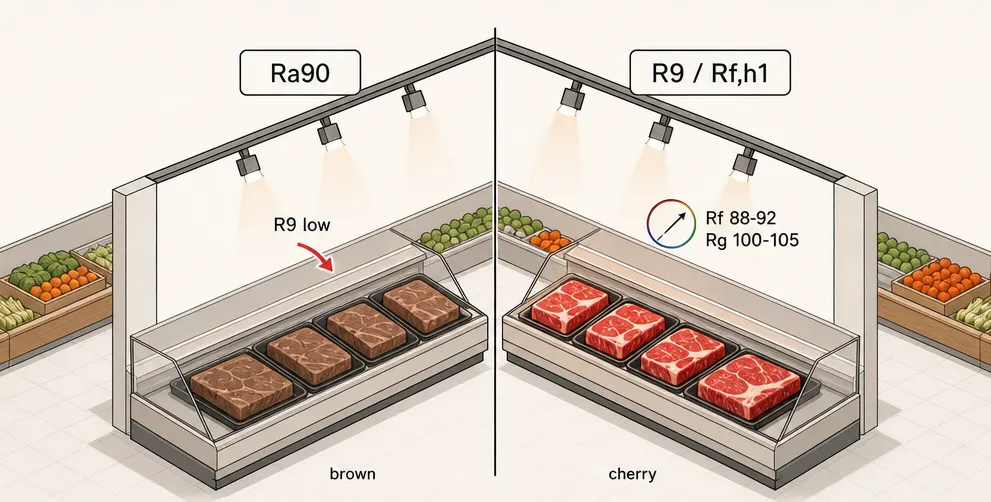
According to the International Commission on Illumination (CIE), the body that defines CIE Ra, general CRI (Ra) is the mean of eight pastel test colours (R1 to R8) under a reference source at the same correlated colour temperature (CCT). Saturated red R9 is not in that mean. A phosphor can lift the eight pastels, pass Ra90, and still leave R9 at 25 because the deep-red slice near 640 nm is thin. The eye sees that slice first on meat, lipstick and burgundy knitwear — the very goods a retail store sells by colour — while the label still reads CRI90. The China December 2023 measure that banned meat-disguising red lamps makes the same point from the regulator side: a narrow red spike that repaints ageing meat is not colour rendering, it is colour repainting.
- Ra is an eight-patch mean — no saturated red inside, so Ra90 with R9 25 is compliant and visibly brown on beef.
- R9 is one deep-red patch — the meat gate; without it, apparel reds also flatten and skin goes sallow.
- Kelvin does not fix it — 3000K warm white can be Ra90/R9 20 or Ra90/R9 85 with the same CCT name, only the report tells them apart.
- Two Ra80 boxes differ — the same Ra80 can hide different R9 values, which is why two CRI 80 LEDs can look different under TM-30 and why buyers must ask for R9 beside Ra.
TM-30 What Changes — 99 Samples, Rf, Rg and the Red Vector
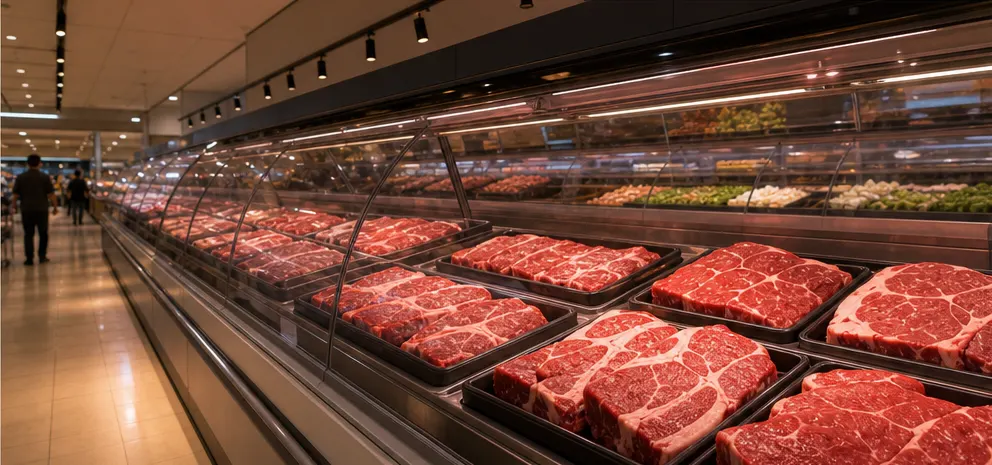
IES TM-30-20, updated to TM-30-24 in 2024, keeps CRI for legacy but adds what CRI cannot see. Rf is the 99-sample successor to Ra, computed in CAM02-UCS uniform colour space and covering paints, textiles, skin and food. Rg reports whether colours on average are more or less saturated than under the reference, with 100 as neutral, above 100 more vivid and below 100 more muted. Crucially, Rf,h1 is the TM-30 analogue of R9 — red fidelity in hue bin 1 — and Rcs,h1 is its chroma shift, so the red can be judged as a vector rather than a single number. A source can be Rf 90 with Rg 100 and still have a pinched red that reads cartoony; the vector catches it, the average hides it. That is the specifier change noted since 2024: architects now ask for Rf with Rf,h1 and the graphic, not Rf alone.
| Metric | What it measures | Samples | Retail read | Buy rule |
|---|---|---|---|---|
| CIE Ra | Average fidelity vs reference at same CCT | 8 pastels R1-R8 | Hides weak red; Ra90 can be R9 25 | Floor: Ra90 every retail counter |
| R9 | Saturated red fidelity | 1 deep red R9 | Beef/knit red vs brown lives here | Meat at least 80, apparel at least 60 |
| TM-30 Rf | Average fidelity vs reference | 99 CES inc. food/skin | Overall accuracy; 100 is perfect | Meat 88-92, other retail 85-90 |
| TM-30 Rg | Average gamut change vs reference | Same 99; vector by hue | 100 neutral; >100 more vivid | 100-105 preference; >110 cartoon |
| Rf,h1 & Rcs,h1 | Red fidelity & red chroma shift | Hue bin 1 around red | Replaces R9 with vector | Report Rf,h1 beside Rf; ask for graphic |

Thresholds by Retail Zone — Meat vs Apparel vs Produce
The same store needs three R9 levels because the eye tolerates different red errors by goods. Meat is the strictest, apparel is the volume, produce is the most forgiving — but all three need Rf and Rg together, not one number. The table below is the buying sheet to paste into a tender so Kelvin alone never decides red. It pairs the LED track light range for retail stores as the overhead layer with the case bar where distance is centimetres, and it maps directly to the department CCT windows in the supermarket fresh food guide, so the two guides read as one system: that guide sets CCT, this guide sets R9/Rf,h1.
| Zone | Typical CCT | CRI / R9 target | TM-30 window | Mount |
|---|---|---|---|---|
| Meat / butchery | 2700-3200K pink-enriched | Ra90 min, R9 ≥80, Rf,h1 ≥78 | Rf 88-92, Rg 100-105 | Track 3.0-3.5m + FLES-M bar 0.1-0.3m |
| Apparel / fashion | 3000-3500K neutral warm | Ra90, R9 ≥60, Rf,h1 ≥60 | Rf 85-90, Rg 98-105 | Track 3.0-4.0m 15-36° accent |
| Produce / bakery | 3000-4000K neutral / 2500-3000K warm | Ra90, R9 ≥50 | Rf 85-90, Rg 98-103 | Track wash or linear run |
| Jewellery / cosmetics | 3500-4000K neutral | Ra90, R9 ≥70 | Rf 88-92, Rg 98-103 | Track 2.8-3.2m narrow spot |
The windows are preference, not cartoon: Rg 100-105 renders honestly and vividly, above 110 looks spray-tanned and triggers returns, below 98 looks washed. For the meat counter that translates to Rg 100-105 with Rf in the high 80s to low 90s and R9 or Rf,h1 above 78 — the IES Annex E preference box that makes food pop without repainting it. The same box explains why a tunable head that only names CCT is insufficient: two 3000K heads can sit at opposite ends of the R9 range and only the report tells them apart.
How to Read the Vector Graphic
Ask for the one-page TM-30 PDF with Rf, Rg and 16 hue-bin arrows, then read red first. The circle is the reference; arrows pointing outward mean that hue is oversaturated, inward means undersaturated, and length is how far. A short or inward red arrow in bin 1 warns that reported R9 may look high on the eight-patch mean while red is pinched in real goods. Check two numbers beside the graphic: Rf,h1 should track R9 within a few points, and Rcs,h1 should sit near 0 to +5 percent for meat preference. Hold the graphic at handover, not just at tender — driver bins and binning shift can move the vector between sample and bulk.
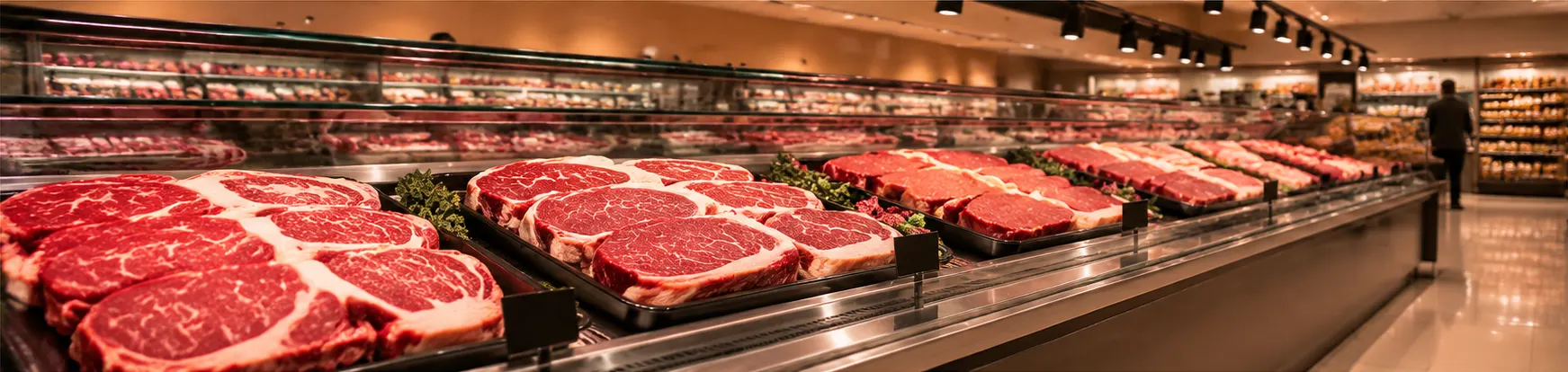
- Good red — Rf,h1 78-85 with a modest outward arrow in bin 1 and Rg 100-105; beef reads cherry, white fat stays white.
- Pinched red — R9 80 but Rf,h1 55 and an inward red arrow; label is good, counter is not — reject or rebalance phosphor.
- Cartoon — Rg above 110 with long outward arrows across reds and yellows; vivid but dishonest, triggers the China 2023 red-lamp concern.
- Washed — Rg below 98 with short inward arrows; accurate average, dull goods — lift Rg toward 102.
How to Verify at Tender and Handover
Write the requirement as five tokens so a distributor can quote without inventing Kelvin: CCT + Ra + R9 + Rf,h1 + Rg. At tender, ask for the integrating-sphere report at the ordered CCT with Ra, R9, Rf, Rg, Rf,h1 and the vector PDF for that exact bin. At handover, spot-check one fitting per circuit with a handheld spectrometer at the product plane — the same 400-800 lux window that the supermarket guide holds — and compare to the tender PDF. If bulk shifts by more than 3 points in R9 or 5 points in Rf, hold the batch and ask for the phosphor lot trace. Keep the check separate from lux: illuminance and colour are proved together at handover, not as two averages.
- Tender line — e.g., 3000K Ra90 R9 at least 60 Rf,h1 at least 60 Rg 98-105 for apparel aisle; 2800K Ra90 R9 at least 80 Rf88-92 Rg100-105 for meat.
- Report per CCT — one report per ordered CCT, not one report for the family at 4000K reused at 2700K.
- Graphic per bin — vector for the shipped bin, not the lab golden sample; pinched red hides in the mean.
- Handover spot — one reading per zone at product height; record lux with colour so brightness never masks hue.
What to Specify Without Reopening Stock
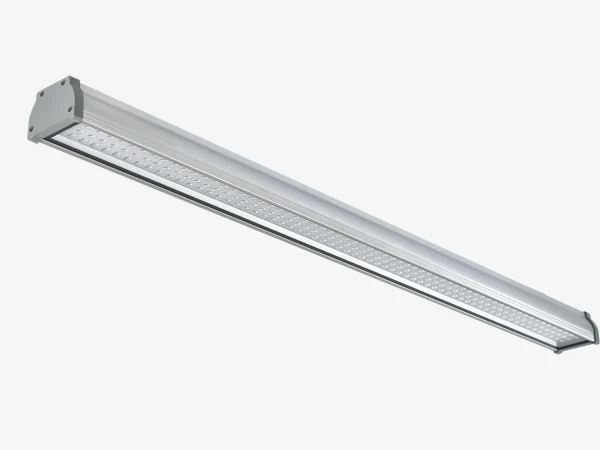
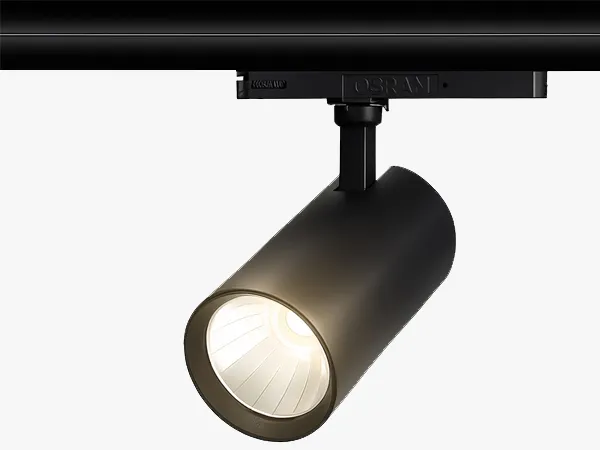
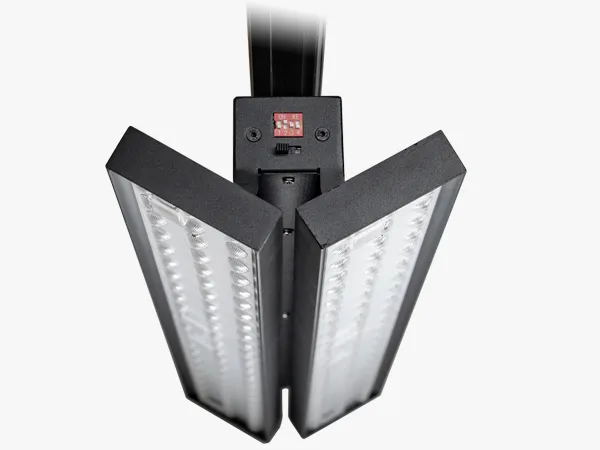
Use the same track head family where possible so one spare covers nine CCT and watt combinations, and reserve the dedicated meat pink for the meat circuit. The VUE-F TR0102 at 15/25/32W up to 4500 lumens at 145 lumens per watt with 15/24/36-degree optics and four food spectra covers the overhead layer that this CRI R9 vs TM-30 Rf Rg guide for retail stores banks on; the FLES-M LC-MB01-24W at 20-30W linkable to 660W with IP65 aluminium and glass covers the case layer where pink must be closest to product; the VUE-S TR0103 at 20/25/32W Ra90 covers the packaged surround so the fresh counter is not lit by spill from the general aisle. For chains that need one SKU instead of many, see the CCT and power selectable VUE-D 650 with nine combos in one housing — it keeps the R9/Rf,h1 promise while cutting spares.
Keep the control hand-off explicit: a tunable driver where bakery and produce share a rail, a separate circuit where meat keeps its pink, and DALI or BLE mesh dimming from 1 to 100 percent so the schedule layer can trim without swapping heads. The how-many-downlights counting method and the daylight harvesting dimming approach already cover lux and daylight trim; this guide adds the colour proof that makes the lux read as fresh rather than merely bright.
FAQ
- Ra averages eight pastels with no deep red, so Ra90 can still be R9 25 and make beef brown.
- Meat preference needs Rf 88-92 with Rg 100-105, not just Ra90.
- Ra hides weak red; Rf with 99 samples covers skin, textiles and food in CAM02-UCS.
- Rg 100 is neutral, 100-105 is preference, above 110 looks cartoony.
- Outward arrows mean oversaturation for that hue, inward means undersaturation.
- Always check bin 1 red: Rf,h1 should track R9 within a few points.
- All three keep Rg 98-105; above 110 is oversaturated and below 98 is dull.
- Jewellery tightens to R9 at least 70 even when apparel relaxes.
- Require Ra, R9, Rf, Rg, Rf,h1 and the vector PDF for the shipped bin.
- Record lux with colour; hold bulk if R9 shifts more than 3 points or Rf more than 5.
- All three use the same track or case mount so thresholds are met by swapping the head, not the ceiling.
- VUE-D 650 keeps one SKU for nine CCT and watt combos where spares must be minimal.
Conclusion
Write colour with five tokens — CCT plus Ra plus R9 plus Rf,h1 plus Rg — and the store stops buying Kelvin and starts buying red. Meat wants Ra90 with R9 at least 80 and Rf 88-92 at Rg 100-105, apparel wants R9 at least 60 with Rf 85-90, produce sits lower but still needs the vector, and the graphic decides the batch before the rail is hung. Sized that way, one family covers cherry meat and true apparel without cartoon, and the lux already proved in the office downlight method reads as fresh rather than merely bright. For the next fit-out, send the CCT list with the R9/Rf,h1 thresholds in this guide and ask for the per-bin vector — the red you keep on the report is the red you keep at the till.
CRI is the CIE Ra average of eight pastels — a source can be Ra90 while R9 is 25 — so new standards such as IES TM-30 with 99 samples have begun replacing CRI among professional lighting designers.
Sources
- International Commission on Illumination (CIE), CIE standards for colour rendering (CIE Ra definition) — Ra from eight test colours, R9 outside the mean.
- Wikipedia, Color rendering index — Ra versus R9, eight versus 99 samples, and TM-30 succession.
- IES TM-30-20 (2020, updated TM-30-24 in 2024), IES method for evaluating light source colour rendition (Rf, Rg, Rf,h1) — 99 CES, CAM02-UCS, hue-bin vectors and Annex E preference windows.
— WHY BUYERS WORK WITH LOW CARBON TECLUX
About Low Carbon Teclux
Low Carbon Teclux Co., Ltd. has manufactured LED commercial lighting since 2010. As a factory-direct OEM/ODM manufacturer, we serve importers and distributors across Europe and Australia — from product selection and sample testing to mass production and delivery, one team covers engineering, manufacturing and sales.
Our Engineering Support
We help project buyers select the right fitting, optic and driver — not just compare prices. Send us your application, mounting height, target lux, dimming protocol and finish requirement, and our engineers will recommend a series, optic, driver basis and spare-parts plan for your RFQ. Where no standard fitting fits, we co-develop custom luminaires around your project — housing, optic, driver and finish engineered to your spec, from prototype to mass production.
REQUEST A QUOTECOMPANY PROFILE // DATA_SHEET
NAME
Low Carbon Teclux Co., Ltd.
BRAND NAME
Low-Carbon
BUSINESS TYPE
LED Lighting Manufacturer
SERVICE
Factory Direct / OEM / ODM
MAIN PRODUCTS
LED Track Lights, Linear Lights, Downlights, Outdoor Luminaires
CAPABILITY
Engineering, Manufacturing & Sales in One Team; Sample to Mass Production
CERTIFICATIONS
CE / FCC / RoHS / ISO9001
EXPORT REACH
Europe & Australia
Contents Table
Need Help Selecting the Right Luminaire?
Tell us your application, mounting height and target lux — our engineers will recommend a fitting, optic and driver configuration, or co-develop a custom fitting when no standard model fits.
REQUEST A QUOTESend Message
Fill out the form and we will get back to you as soon as possible