 John, Sales ManagerIndustry News
Dim to Warm Lighting Guide for Restaurants and Hotels
Introduction
This dim to warm lighting guide for restaurants and hotels explains how one slider carries a dining room from bright service to late amber mood. A dim-to-warm fitting starts near 3000K at full output and slides toward 1800K candlelight as it dims, copying the familiar behavior of incandescent and halogen lamps. Because color follows brightness on a single control signal, operators get the whole evening arc without touching a second dial.
According to the U.S. Department of Energy guide to color-tunable products, this linked dimming is exactly why restaurants, hotel lobbies, guestrooms and ballrooms prize the technology — rooms that must feel right at every hour of the day.
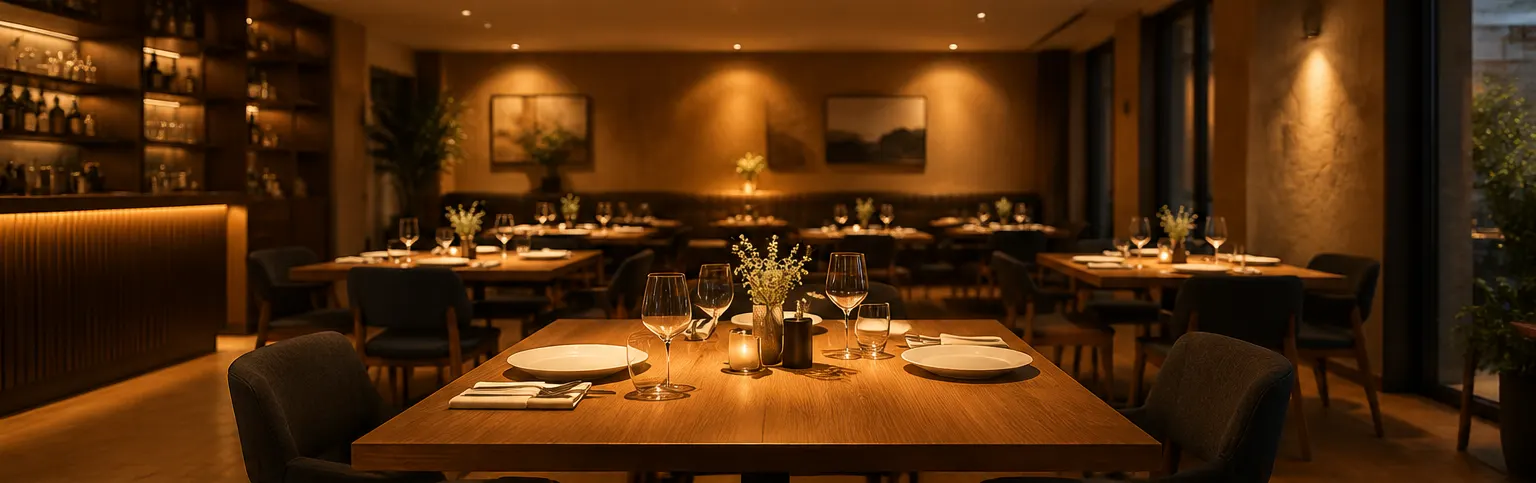
How Dim-to-Warm Shifts Color
A dim-to-warm module carries two diode groups — cool white and warm white — plus one driver-side curve that decides their mix. At full output the cool group dominates; as the single brightness command falls, the driver throttles the cool group and feeds the warm group as output drops. No second signal ever enters the fitting.
According to the QTL note on warm-dim technology, the strip translates the input signal from the power supply: full intensity lights the cooler chip, dimming blends toward warm, and low on the curve the cool chip switches off entirely. That is why every protocol in the next sections works with the same fitting: each only has to deliver brightness, and the curve inside the driver does the color work.
The Evening Half of Human-Centric Lighting
Is dim-to-warm a human-centric lighting concept? Only half of it. Human-centric schemes track the sun in both directions: bright cool light by day, warm dim light at night. Dim-to-warm handles the evening leg beautifully and cannot do the morning one, since its hardware has no independent cool-bright channel. Naming it the evening half keeps the claim honest and still gives buyers a real physiological reason to specify it.
According to the Brown and colleagues consensus recommendations on indoor light exposure, healthy adults want at least 250 melanopic EDI at the eye during daytime, no more than 10 in the three hours before sleep, and near darkness overnight. Melanopic EDI measures how strongly light stimulates the retinal cells that steer circadian rhythm, and evening light should be depleted in short wavelengths near the 480 nm melanopic peak. Dimming toward 1800K does exactly that: it lowers room lux and drains blue content at the same time.
| Time of day | Target at the eye | What the dining room does |
|---|---|---|
| Daytime | 250 melanopic EDI minimum | Bright neutral service light, daylight where windows allow |
| Evening, 3 hours before sleep | 10 melanopic EDI maximum | Dim-to-warm arc down to candlelight over tables |
| Night | 1 melanopic EDI maximum | Corridors and guest floors near dark, task light only |
One caution belongs in every specification: equal CCT numbers do not guarantee equal circadian effect, because two lamps at the same white point can carry different melanopic content. Treat 1800K as the mood direction, not a medical dose, and judge fixtures by dimming smoothness and low-end color honesty rather than CCT digits alone.
Dim-to-Warm Versus Tunable White
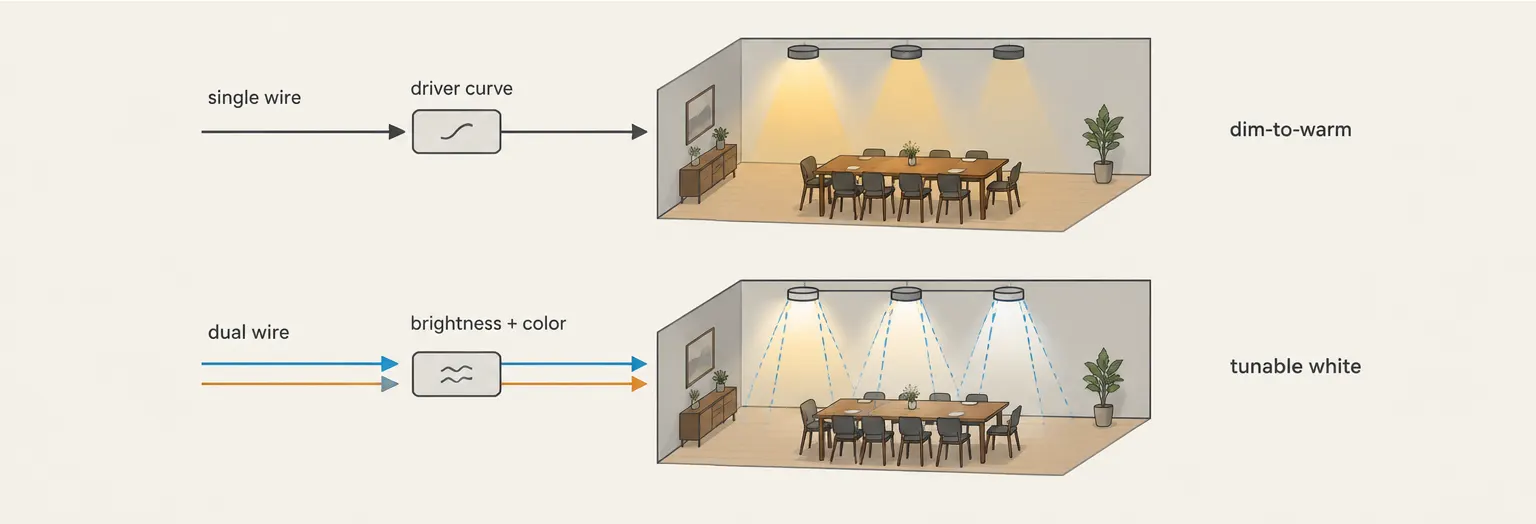
Buyers often ask for tunable white when dim-to-warm is the cheaper correct answer, or the reverse. The split is simple: dim-to-warm binds color to brightness, while tunable white frees them — the table below turns that split into wiring and retrofit cost.
| Point | Dim-to-warm | Tunable white |
|---|---|---|
| Control handles | One: brightness drives color automatically | Two: brightness and color set independently |
| DALI wiring | Single-channel driver on one address | DT8 driver carries both channels on one address; DT6 needs two |
| Retrofit | Phase-cut wall dimmer often reusable, no new bus | Usually a new control bus plus commissioning |
| Best fit | Dinner service, lobbies, guestrooms, bars | Meeting rooms, classrooms, daytime circadian scenes |
Protocol choice matters beyond this page, so compare the wires before budgeting: our dimming protocol comparison for TRIAC, 0-10V and DALI shows where phase-cut stops being smooth and a digital bus takes over.
Which Dimming Protocols Suit Dim-to-Warm
Because color is derived from brightness, dim-to-warm accepts any system that can carry one dimming signal — wired or wireless. The Department of Energy names phase-cut, 0-10V, DALI and DMX, plus luminaires with wireless Zigbee, WiFi or Bluetooth receivers — the matrix below matches each signal to the building it suits best.
| Protocol | What it carries | Where it wins |
|---|---|---|
| TRIAC phase-cut | Brightness on the mains wire, no signal cable | Retrofits that keep existing wall dimmers; low-end steps vary by dimmer brand |
| 0-10V | One analog brightness channel on signal wires | Simple commercial zones; warm-dim drivers accept a 0-10V input directly |
| DALI | Digital brightness, one DT6 address per curve | Addressable scenes per table zone; DT8 where the system also sends color |
| DMX | Fast digital brightness per channel | Bars and clubs with desk-driven show scenes |
| Bluetooth mesh | Brightness scenes from app, switch or timer | Smart homes and refits with no new control wiring at all |
For whole floors without signal wiring, wireless BLE mesh dimming across sales floors and lobbies carries the same single brightness command over the mesh, so a dim-to-warm group joins scheduled scenes like any other fitting.
Scenes in Restaurants and Hotels
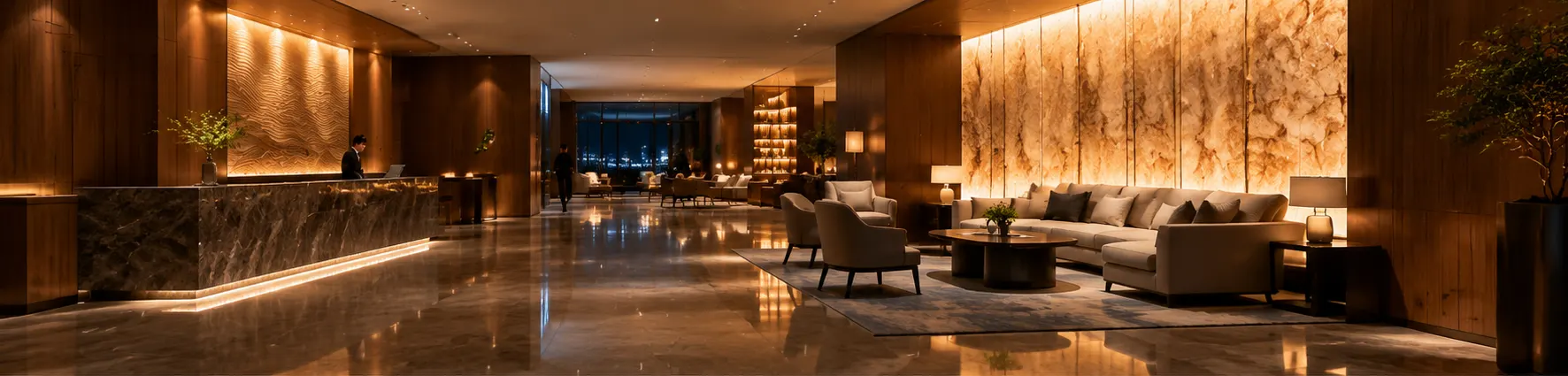
A dim-to-warm room earns its keep across the service clock. Lunch runs near full output as clean inviting white, the dinner rush dims into amber, and late seating drops toward candlelight while tables stay readable. Hotel lobbies follow the same arc from daytime arrival brightness to evening lounge warmth, and guestrooms wind down with one bedside slider instead of a scene panel guests never learn.
Dining rooms carry the evening arc
Keep the arc on the guest-facing layers only: pendants and downlights over tables plus wall washing in the background. Kitchens, passes and bars keep fixed-white task light so staff keep full visual performance while guests get the mood. When zones need clock-driven recall on top of dimming, our guide to scheduling Trading, Stocking and Eco scenes shows how to stack timers over dimmed layers.
Lobbies and guest floors stay simple
One grouped controller per lobby zone beats per-fixture apps that staff will not maintain. Corridors hold steady low light for safety and let the feature walls do the warming, which also protects the overnight melanopic budget from the table above.
Fixtures That Suit Dim-to-Warm
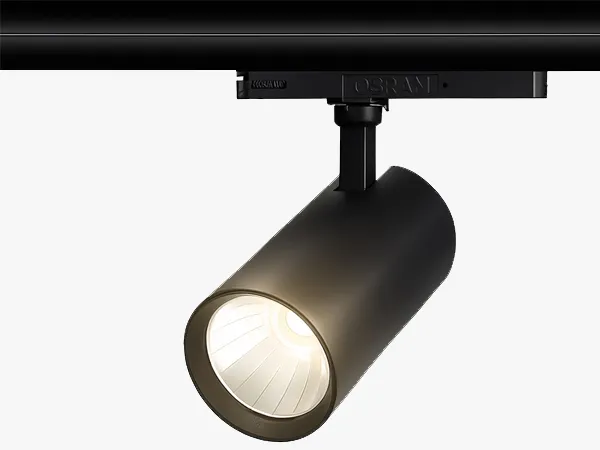
Dim-to-warm lives in directional point sources: recessed downlights over tables, track heads over bars and display walls, pendants over counters, wall washers in lounges, and filament-style retrofit bulbs where heritage holders must stay. What unites them is optical mixing without double shadows plus a driver curve with no visible steps on the way down.
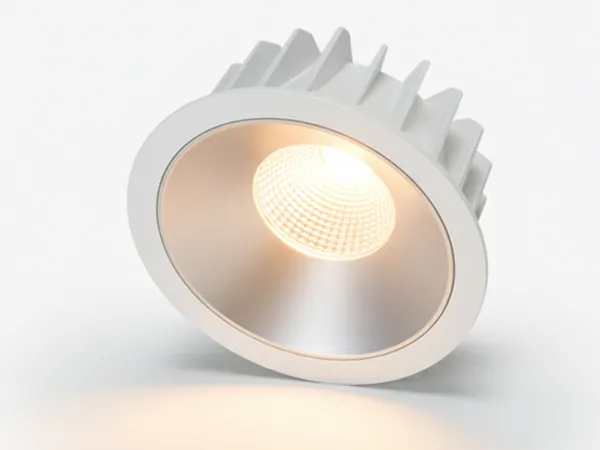
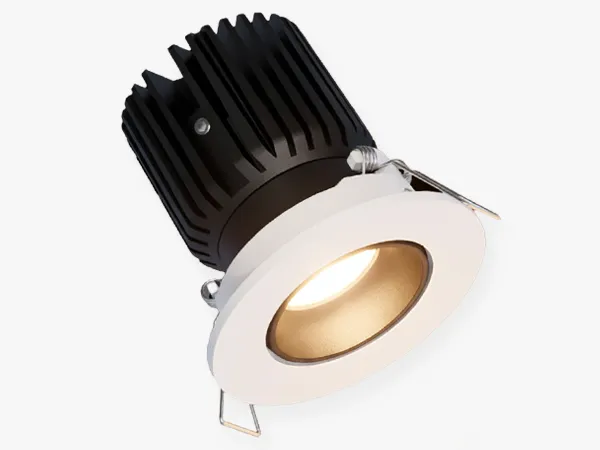
Two housings cover most hospitality refits. The anti-glare downlight family for hotel dining rooms offers high color rendering with Ra90 and UGR22 comfort optics, so tables get warm pools without glare complaints. Where ceilings already hold TRIAC wall dimmers, the TRIAC wall-dimmer spotlight for boutique ceilings dims off the existing dimmer with a 30-degree tilt for re-aiming displays.
DK1916 Light Source: One Engine, Three Curves
The DK1916 dim-to-warm source we specify in our hospitality fittings is built for exactly this logic: LM-80 tested diodes, color rendering above Ra90, and a halogen-like dimming curve burned into the driver. One sourced engine ships in three CCT spans, so a single stock line covers three project moods from fine dining to daylight-bright commercial floors.
| DK1916 range | Full output | Bottom of curve | Suits |
|---|---|---|---|
| 1800-3000K | Clean warm service white | Candlelight amber | Fine dining rooms and bars |
| 2200-4000K | Neutral task white | Warm amber | Hotel lobbies and high-end commercial spaces |
| 1800-5000K | Daylight cool white | Candlelight amber | Smart homes and multipurpose halls |
Pairings decide the effect. A DK1916 inside the SP01 tilt spotlight turns each table into its own sunset: menus stay readable near full output, then the beam glides to amber for late seating — all from the existing wall dimmer. The same source inside DL01 downlights washes lobbies and dining ceilings in glare-free warm pools, and on Bluetooth mesh hardware it joins app scenes and timers for smart-home wind-down routines.
Buying Checks Before You Order
- Curve depth — confirm the bottom number on the datasheet: professional curves reach about 1800K, while shallow consumer bulbs stop near 2200K and never deliver late-dinner amber.
- Low-end color honesty — check CRI at the lowest dimming step and hold 80 or above, since amber-only low ends can turn skin tones eerie.
- Dimmer compatibility — phase-cut reuse is convenient but low-end smoothness varies by dimmer brand, so test the exact pairing before rollout.
- Efficacy trade-off — dim-to-warm systems run below fixed-white efficacy at equal CCT, so compare lumen claims at the same color point, not at maximum output.
FAQ
Conclusion
Specify dim-to-warm as the evening half of a human-centric room: one slider, a verified curve to 1800K, honest low-end color, and housings that mix without steps. Schedule the clock scenes on top, and compare dimmer pairings before rollout. For the next guide in sequence, browse more guides in our Industry News library to pair this page with dimming and scheduling companions.
Daytime rooms want strong circadian light at the eye, evenings want it near gone, and dim-to-warm earns its place by draining both brightness and blue content in one slider move. That is why dining rooms and lobbies suit it while meeting rooms need independent color control.
Sources
- Brown et al., Recommendations for daytime, evening, and nighttime indoor light exposure (PLoS Biology, 2022): 250 melanopic EDI daytime minimum, 10 evening maximum from three hours before sleep, 1 overnight maximum, measured at the eye.
- U.S. Department of Energy, Understanding LED Color-Tunable Products: dim-to-warm definitions at 2700-3000K to 1800K, single-signal controls, hospitality applications and the low-end CRI 80 rule.
- QTL, The Evolution of Warm Dim and Tunable White LED Technology (2023): cool and warm diode pairs with a driver-side blend curve, warm-dim on 0-10V or two-wire phase-dim drivers.
— WHY BUYERS WORK WITH LOW CARBON TECLUX
About Low Carbon Teclux
Low Carbon Teclux Co., Ltd. has manufactured LED commercial lighting since 2010. As a factory-direct OEM/ODM manufacturer, we serve importers and distributors across Europe and Australia — from product selection and sample testing to mass production and delivery, one team covers engineering, manufacturing and sales.
Our Engineering Support
We help project buyers select the right fitting, optic and driver — not just compare prices. Send us your application, mounting height, target lux, dimming protocol and finish requirement, and our engineers will recommend a series, optic, driver basis and spare-parts plan for your RFQ. Where no standard fitting fits, we co-develop custom luminaires around your project — housing, optic, driver and finish engineered to your spec, from prototype to mass production.
REQUEST A QUOTECOMPANY PROFILE // DATA_SHEET
NAME
Low Carbon Teclux Co., Ltd.
BRAND NAME
Low-Carbon
BUSINESS TYPE
LED Lighting Manufacturer
SERVICE
Factory Direct / OEM / ODM
MAIN PRODUCTS
LED Track Lights, Linear Lights, Downlights, Outdoor Luminaires
CAPABILITY
Engineering, Manufacturing & Sales in One Team; Sample to Mass Production
CERTIFICATIONS
CE / FCC / RoHS / ISO9001
EXPORT REACH
Europe & Australia
Contents Table
Related Product
Need Help Selecting the Right Luminaire?
Tell us your application, mounting height and target lux — our engineers will recommend a fitting, optic and driver configuration, or co-develop a custom fitting when no standard model fits.
REQUEST A QUOTESend Message
Fill out the form and we will get back to you as soon as possible