 John, Sales ManagerIndustry News
LM-80 vs TM-21: How to Verify LED Lifetime Claims
Introduction
If a datasheet quotes a lifetime in hours with no case temperature and no test duration, treat the figure as a design target rather than a rating. LM-80 vs TM-21 is the pair of standards that decides whether the number survives scrutiny: LM-80 measures lumen maintenance on a sample of LED packages, arrays or modules for at least 6,000 hours, and TM-21 projects beyond that measured data with a ceiling of six times its duration. Six thousand hours of testing therefore supports a 36,000-hour claim, and a 100,000-hour claim needs at least 16,667 measured hours behind it.
This guide reads a lifetime statement the way a buyer has to read it: which of the three numbers on the page is actually being promised, what the test covered, where the projection stops, and which questions turn a sales figure into evidence. The worked examples use the FORT-A-HT high bay rated at 60 °C ambient and a repairable supermarket trunk, both of which publish hours and driver class as separate lines rather than as one headline.
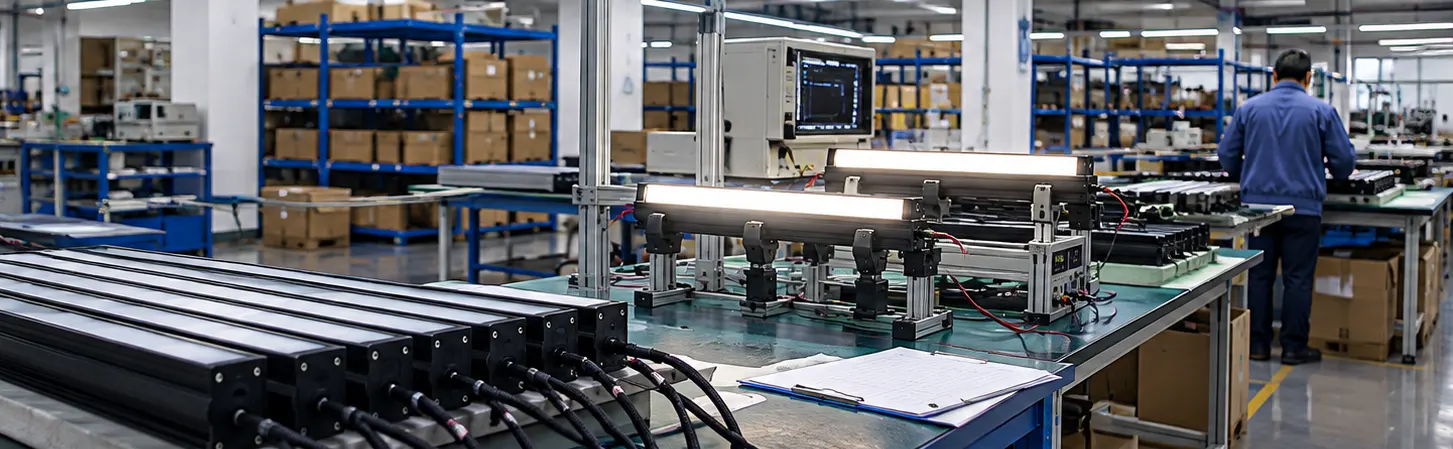
One Lifetime Figure Is Really Three Numbers
A single "50,000 hours" on a specification sheet hides three measurements that age at different rates and are covered by different documents. The LED source loses flux gradually, the driver's electrolytic capacitors age with ambient temperature, and the warranty is a commercial promise that may cover one part, both parts, or neither in year six.
| Figure on the sheet | Measured on | Standard | What it ignores |
|---|---|---|---|
| Lumen maintenance, LxBy | LED package, array or module in a lab at set case temperatures | ANSI/IES LM-80 plus TM-21 | Driver, optics, gaskets, surge |
| Luminaire maintenance | The complete fitting, running in situ | ANSI/IES LM-84 plus TM-28 | Driver electronics, control gear |
| Driver life | Driver at its rated ambient or case temperature | Driver maker's data, often Arrhenius-based | LED flux depreciation |
| Warranty | The contract | Commercial terms | Physics, unless the terms name a failure criterion |
Ask which row a figure belongs to before comparing two products. A 100,000-hour source sitting behind a 30,000-hour driver is a 30,000-hour fitting, and the datasheet that adds the two together has told the buyer nothing about either. Fittings in the linear high bay and trunk light range keep the two rows apart for exactly that reason.
What LM-80 Tests, And What It Leaves Out
LM-80 is a measurement method rather than a pass or fail test. A laboratory drives a sample at a fixed current, holds the case temperature at defined points, and reads luminous flux every 1,000 hours inside a tolerance window of about 48 hours. The minimum run is 6,000 hours; 10,000 hours is the duration most programmes prefer, because every extra 1,000 measured hours extends the reach of the projection.
Temperature coverage differs between editions, and the difference matters when a hot site is being quoted. ANSI/IES LM-80-08 asked for three case temperatures, usually 55 °C, 85 °C and one chosen by the maker. ANSI/IES LM-80-15 requires a minimum of two, at least one of which must be 55 °C or 85 °C. A report with a single temperature point can still be valid, but it can only answer for that one thermal condition.
Three limits follow from the method itself. LM-80 says nothing about the driver, the lens, the gasket or the solder joints. The sample size sets how far the data can be pushed, with 20 units needed for the full multiplier and 10 to 19 units capping projections at 5.5 times the test duration. And a luminaire that runs hotter or harder than the tested current has left the data behind, no matter how impressive the projection looks.
The 6X Ceiling, And What Testing Time Buys
According to the Illuminating Engineering Society position on LED product lifetime prediction, projections using 10,000 hours of LM-80 data may never exceed 60,000 hours, and a 100,000-hour L70 claim is not supported by IES standards. The rule exists because the curve fit loses statistical confidence as it runs past the measured region, so the projection is capped at six times the test duration.
| Measured LM-80 data | Claim ceiling | Continuous test time | What it buys |
|---|---|---|---|
| 6,000 hours | 36,000 hours | About 8 months | Minimum credible claim |
| 8,000 hours | 48,000 hours | About 11 months | Retail and office projects |
| 10,000 hours | 60,000 hours | About 14 months | Programme-grade figure |
| 12,000 hours | 72,000 hours | About 16 months | Long-life industrial |
| 16,667 hours | 100,000 hours | About 23 months | The only route to six figures |
Read the table as a budget rather than a target. Each additional 1,000 hours of measured data buys 6,000 hours of claimable life, so a supplier quoting 100,000 hours either started the test two years before launch or is reporting a calculated value that the standard does not recognise. The distinction has a name in the trade: reported values sit inside the 6X limit, calculated values sit beyond it and have no practical meaning.
One more check catches most of the inflated figures. A projection is only as good as the data window it used, and TM-21 Addendum B changed the window for long tests: from 6,000 to 10,000 hours of data, the fit uses the last 5,000 hours rather than everything collected. A report that quotes a curve fit on the first 6,000 hours of a 10,000-hour test has used the wrong slice.
Temperature: Where Most Reports Stop Applying
TM-21 allows interpolation between the measured case temperatures and forbids extrapolation above them. When the in-situ temperature sits above the highest LM-80 point, there is no projection to quote; when it sits below the lowest point, the standard directs the user to the lowest measured data rather than to a cooler, more flattering curve. That single rule decides whether a report covers a given installation.
In practice the in-situ figure comes from an In-Situ Temperature Measurement Test, the ISTMT, run on the assembled fitting at its rated drive current. Qualification programmes require that test for the LED, and higher tiers also require it for the driver, which is why a serious datasheet can quote a case temperature and a driver ambient separately. A 78 °C ISTMT reading against 55 °C and 85 °C data points is a valid interpolation; the same reading against a single 55 °C point is not covered at all.
Hot processes make the rule bite. A melt shop or a paper dryer running near 60 °C at the fitting needs LM-80 data that reaches that temperature and a driver rated for it, which is a different question from the lumen-maintenance curve; the guide to 60 °C high bay ageing covers the thermal side. For the paperwork, the action is simple: put the ISTMT value beside the report's temperature column and stop reading when the value falls outside it.
L70B50: The L Is The Level, The B Is The Spread
L70 marks the point where output reaches 70 percent of its initial value, and it is a parametric threshold rather than a switch-off point. Light continues after L70, just below the level the design was built around. The letter after the L sets that level; the letter after the B sets how much of the population is allowed to fall short of it.
B50 means half the units fall below the stated level at the stated hours, and it is the default behind a bare "L80 50,000 h" line, because IEC 62717 and IEC 62722-2-1 treat the median useful life as B50 by definition. B10 is the stricter reading: only a tenth of the population may fall short. The same standards split gradual depreciation, written LxBy, from abrupt failure, written LxCy, and both must be declared at a rated ambient temperature rather than in a vacuum.
Two consequences matter at the tender stage. An L90B50 50,000-hour fitting keeps 20 percentage points more light than an L70B50 50,000-hour fitting at the same hour, so the pair cannot be compared on hours alone. And a lumen-maintenance figure says nothing about the share of units that stop working, which is why the US Department of Energy recommends pairing a B value with an F value, such as B50 for depreciation and F10 for sudden failure.
When The Claim Has To Cover The Whole Fitting
There is a second route that tests the luminaire rather than the source. ANSI/IES LM-84 runs the complete fitting on test, so the measurement captures driver drift, lens yellowing and reflector ageing as well as the LEDs, and TM-28 turns that data into a projection. Six thousand hours of LM-84 data can be projected directly; between 3,000 and 5,999 hours the method combines the fitting data with source-level LM-80 data for the same LEDs.
According to the ENERGY STAR luminaire specification, a qualifying indoor fitting must project L70 of at least 25,000 hours, an outdoor fitting 35,000 hours, and a fitting whose source cannot be replaced 50,000 hours, measured either through LM-80 with TM-21 or through LM-84 with TM-28. Those thresholds are modest on purpose: they are the level a programme can actually verify, not the level a brochure prefers to print.
The practical test is scope. A lumen-maintenance figure built on source data describes the LED package; a figure built on LM-84 describes the object that hangs on the ceiling. When a supplier offers six figures for a sealed fitting with an integrated driver, the buyer should ask which of the two tests produced it, because only the second one has seen the driver age.
The Failures LM-80 Never Sees
Drivers fail before LEDs in most field data, and the failure is thermal rather than photometric: an electrolytic capacitor dries out faster as its ambient climbs, and no LM-80 report will ever show it. Solder joints crack under thermal cycling, gaskets harden, lenses yellow, and a surge event can end a fitting on day one. A lifetime claim that covers the LED and ignores these mechanisms is a partial statement presented as a whole one.
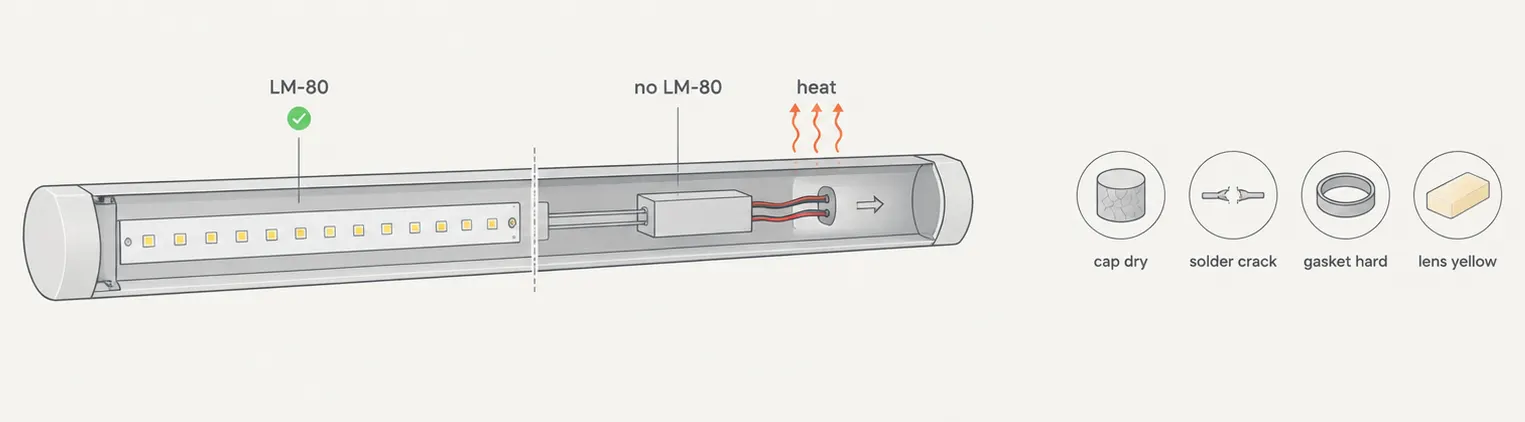
Splitting the statement is the honest fix, and it is what the FORT-A-HT 60 °C high bay does: the hours are quoted at a stated ambient and the driver class is listed separately, so the buyer can see that two components carry two ratings. The EVAL-E supermarket trunk takes the same logic into maintenance, with a driver that can be swapped on site while the trunk stays hung, which turns a driver failure into a parts cost rather than a ceiling job.
Once the fitting is in service, the only reliable count of elapsed hours comes from the luminaire itself. A DALI-2 D4i driver exposes an operating-hours counter that a gateway can read, so replacement planning can follow measured hours instead of the commissioning date. That counter is also the cheapest audit available: if a site claims 40,000 hours of use, the driver can confirm or contradict it.
Eight Questions To Send With The RFQ
A lifetime claim becomes evidence when the supplier can answer these eight questions in writing. Any of them left blank is a gap the buyer carries into the warranty period.
- Test duration and temperature points — how many hours of LM-80 data, at which case temperatures, and at what drive current?
- Reported or calculated — is the TM-21 output inside the 6X limit, and which edition of the method was used?
- L and B values — what level and what population share are attached to the hours being quoted?
- ISTMT reading — what temperature was measured at the hottest LED in the assembled fitting, and does it fall inside the LM-80 columns?
- Scope of the test — source-level projection only, or LM-84 data on the complete fitting?
- Driver rating — what ambient or case temperature is the driver rated at, and what is its own life figure?
- Warranty coverage — driver, LED module, labour and freight, for how many years, and what triggers a valid claim?
- Failure criterion — is the end of life written as a lumen level at a population share, and who arbitrates when a site disputes it?
Reading The Reply: A Triage Table
Most replies fall into five shapes. Sorting the reply into one of them takes a minute and settles whether the number can go into a specification.
| What the supplier sends | What it actually proves | Next move |
|---|---|---|
| Hours only, no temperature or duration | A design target | Request the LM-80 report before pricing |
| LM-80 report, no ISTMT | The source was tested, the fitting was not | Ask for the ISTMT on the assembled product |
| 100,000 hours projected from 6,000 hours | A breach of the 6X limit | Reject the figure, keep the product under review |
| 10,000 hours at 85 °C plus a 78 °C ISTMT | A valid interpolation, ceiling 60,000 hours | Accept up to that ceiling, in writing |
| LM-84 data of 6,000 hours or more | The complete fitting aged on test | Strongest evidence available, and it covers driver drift |
Proving The Number After Handover
A projection is a forecast, and a forecast can be checked. Three readings close the loop on a live site.
- Thermal spot check — measure the driver case and the LED board temperature on one fitting per circuit and compare with the commissioned ISTMT; a 10 °C drift moves the projection by years, not months.
- Illuminance re-check — compare measured lux with the design value multiplied by the maintenance factor, so a 0.80 factor already budgets 20 percent loss and a reading above it is not a fault.
- Runtime counter — read the D4i operating-hours field each quarter, and schedule replacement at 70 to 80 percent of the rated hours rather than when a lamp goes dark.
None of the three needs a laboratory. Together they turn a claimed figure into a maintained one, which is the difference between buying a number and buying a lighting installation that still meets its design level in year eight.
FAQ
Conclusion
LM-80 vs TM-21 is not a contest between two documents; it is a division of labour that ends at a hard ceiling of six times the measured hours. A buyer who knows the ceiling, the temperature column and the difference between an L value and a B value can grade any lifetime claim in minutes, and can tell a tested figure from a target dressed up as one. Ask for duration, temperature and test scope, then accept the number only up to the ceiling the evidence supports.
Projections from 10,000 hours of testing may never exceed 60,000 hours, and the limit exists because the statistical confidence of the model runs out beyond the measured region rather than because the LEDs fail at that point.
Sources
- Illuminating Engineering Society, PS-10-18: IES Position on LED Product Lifetime Prediction (2018) — the 6X extrapolation limit, and why claims beyond it are not supported.
- ENERGY STAR, Program Requirements for Luminaires, V2.0 (2015) — L70 thresholds of 25,000, 35,000 and 50,000 hours, with the LM-80 plus TM-21 and LM-84 plus TM-28 routes.
- DesignLights Consortium, SSL V6.0 and LUNA V2.0 Technical Requirements (2025) — ISTMT on the LED and on the driver as a listing condition.
WHY BUYERS WORK WITH LOW CARBON TECLUX
About Low Carbon Teclux
Low Carbon Teclux Co., Ltd. has manufactured LED commercial lighting since 2010. As a factory-direct OEM/ODM manufacturer, we serve importers and distributors across Europe and Australia — from product selection and sample testing to mass production and delivery, one team covers engineering, manufacturing and sales.
Our Engineering Support
We help project buyers select the right fitting, optic and driver — not just compare prices. Send us your application, mounting height, target lux, dimming protocol and finish requirement, and our engineers will recommend a series, optic, driver basis and spare-parts plan for your RFQ. Where no standard fitting fits, we co-develop custom luminaires around your project — housing, optic, driver and finish engineered to your spec, from prototype to mass production.
REQUEST A QUOTECOMPANY PROFILE // DATA_SHEET
NAME
Low Carbon Teclux Co., Ltd.
BRAND NAME
Low-Carbon
BUSINESS TYPE
LED Lighting Manufacturer
SERVICE
Factory Direct / OEM / ODM
MAIN PRODUCTS
LED Track Lights, Linear Lights, Downlights, Outdoor Luminaires
CAPABILITY
Engineering, Manufacturing & Sales in One Team; Sample to Mass Production
CERTIFICATIONS
CE / FCC / RoHS / ISO9001
EXPORT REACH
Europe & Australia
Contents Table
Need Help Selecting the Right Luminaire?
Tell us your application, mounting height and target lux — our engineers will recommend a fitting, optic and driver configuration, or co-develop a custom fitting when no standard model fits.
REQUEST A QUOTESend Message
Fill out the form and we will get back to you as soon as possible