 John, Sales ManagerIndustry News
Museum Lighting Lux Levels: 50, 200 and 300 Lux Explained
Introduction
Museum lighting lux levels are set by the object rather than by the room: 50 lux for paper, textiles and dyed leather, 150 to 200 lux for oils and wood, 300 lux for stone, metal and ceramics. Every one of those figures is a ceiling, not a target, and the ceiling only holds if the fixture can actually land on it. This guide turns the three bands into the two things a gallery project needs — an exposure budget per exhibition and the beam geometry that puts light on the canvas without washing the wall — and finishes on the dimming floor that decides whether a standard track head can reach 50 lux at all.
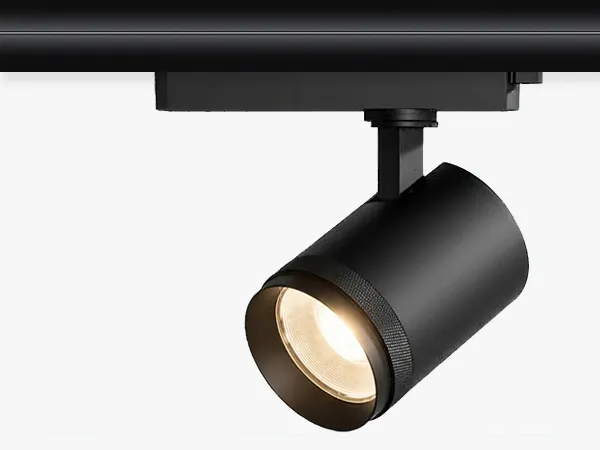
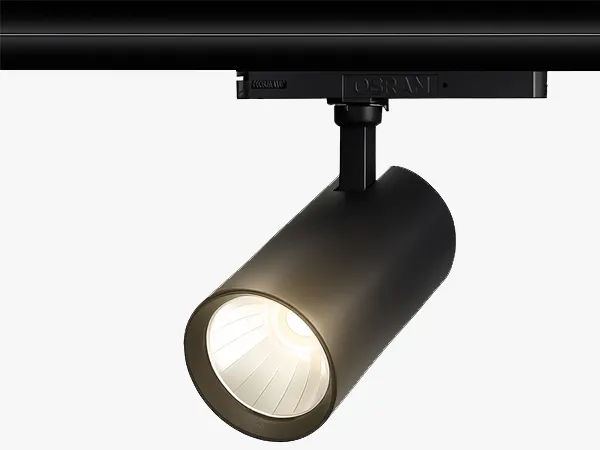
The worked examples use the zoom head that re-aims between shows and a fixed-beam sibling, both Ra90 track spots, so the arithmetic lands on hardware rather than on a datasheet ideal. Daylight ingress, display-case micro-climate and UV filtering sit outside this page; they are separate disciplines that start where the luminaire spec ends. For the family these heads belong to, see the full LED track light range grouped by beam type.
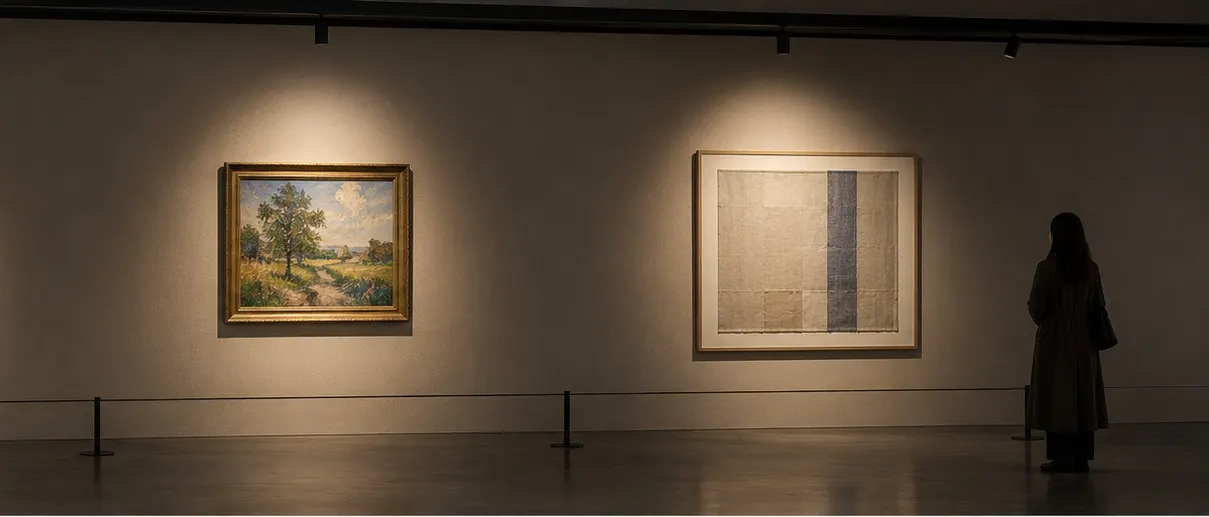
Lux Caps The Exposure, Lux-Hours Set The Budget
According to CIE 157:2004, control of damage to museum objects by optical radiation, photochemical damage scales with the light received over time and with the spectral content of that light, so an illuminance limit without an hours limit says very little. The practical unit is the lux-hour: illuminance multiplied by lit hours. Fifty lux for a hundred hours and a hundred lux for fifty hours both deliver 5,000 lux-hours, and both cost the object the same.
A gallery open seven hours a day, six days a week, runs 2,184 lit hours a year. That single figure converts every band into a calendar. Fifty lux for a full year is 109,200 lux-hours, which already overshoots the 100,000 lux-hour allowance carried by the most sensitive class — so a watercolour cannot sit in a permanent display at 50 lux without rotation. Two hundred lux for the same year reaches 436,800 lux-hours, just inside the 450,000 allowance for moderately sensitive material, which is why oils survive continuous display and paper does not.
| Class | Max lux | Annual cap | Lit hours |
|---|---|---|---|
| Very sensitive: paper, textiles, leather | 50 lux | 100,000 lux-hours | 2,000 h |
| Moderate: oils, tempera, wood, ivory | 150 lux | 450,000 lux-hours | 3,000 h |
| Moderate, upper reading | 200 lux | 450,000 lux-hours | 2,250 h |
| Insensitive: stone, metal, glass | 300 lux | No practical cap | Full opening hours |
Ask the lender or the conservator for both numbers before the lighting plan is drawn, then write them into the exhibition schedule: illuminance on the object and lit hours per year. A plan that quotes only the first will fail its own audit within the first season.
Why 150 And 200 Lux Both Appear For Oils
Published guidance does not agree on the middle band, and that is not an error to resolve. Some conservation bodies cap mid-sensitivity material at 150 lux, others at 200 lux, and loan agreements often land on a third number chosen by the lender's insurer. When two figures conflict, the stricter one governs the wall, because the object belongs to the lender and the exposure is cumulative across every venue it visits.
Ultraviolet radiation is treated separately from visible light. The usual ceiling is 75 microwatts per lumen, a threshold that modern white LED engines clear easily because they emit almost no UV below 400 nm. That is a genuine advantage over halogen and fluorescent sources, which pushed both UV and infrared heat onto the surface. It is also the point where most specifications stop too early.
Record the two numbers on the wall label in the store room, not only in the project file: the technician who re-aims a head next season will not read the file. Conservators measure at the object, with the meter held on the surface plane, and a handover sheet that lists point-by-point readings is worth more than a design statement.
Why Low UV Does Not Mean Low Damage
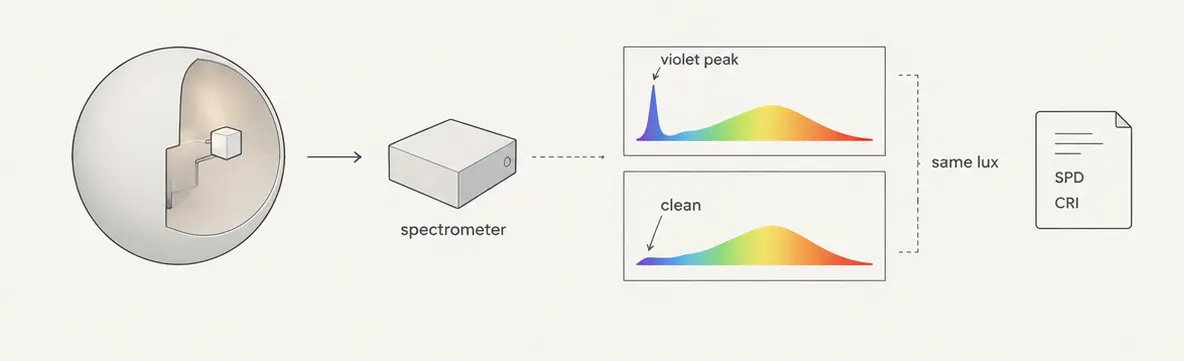
According to the Canadian Conservation Institute, LED lighting in museums and art galleries, LED sources are preferred for their low UV and low heat, yet the same bulletin warns that a violet peak near 405 nm adds damage while contributing little to the lux reading. Damage is weighted toward short wavelengths, so two lamps at identical lux can age a dye at different rates.
That is why "UV free" is a starting condition rather than a verdict. Request the spectral power distribution for the exact CCT and current you will run, and compare the 400 to 450 nm region between candidates. A lamp with a cleaner short-wave profile at the same lux and CRI is the safer specification, and the difference is visible in the SPD long before it is visible on the object.
Colour At 50 Lux: CRI 90 Is The Floor, R9 Is The Test
The same Canadian Conservation Institute bulletin moves the colour target to CRI 90 and above for museum work, and separates the red sample: R9 of at least 50 is the minimum it calls acceptable, with R9 of 90 the aspiration where reds matter. Most commercial downlights and spots sit in the high seventies on CRI and score poorly on R9, which is why cheap white light makes textiles and varnished wood look flat rather than merely dim.
Low illuminance makes the problem sharper, not softer. At 50 lux the eye has less signal to work with, so a weak red rendering reads as grey and a green shift reads as discolouration. If you need the full comparison between average CRI, R9 and the TM-30 pair Rf and Rg, the guide to how R9 and TM-30 Rf diverge covers the measurement side; for a gallery the short version is to specify Ra90 with R9 stated, and to keep one CCT across a room so adjacent works do not shift against each other.
The 30-Degree Museum Angle, In Numbers
Aim a head straight down a wall and the light rakes the surface: brushwork and relief throw hard shadows, and the frame casts a band across the top of the work. Aim it too far out into the room and the visitor's own shadow lands on the canvas, while glazed or varnished surfaces send the reflection straight back into the viewer's eye. Gallery practice settles on 30 degrees from vertical because that is where the specular reflection drops to the floor instead of into the face, and where texture reads as texture rather than as damage.
The geometry is one number. Setback from the wall equals the vertical distance from the head to the centre of the work multiplied by 0.577, the tangent of 30 degrees. A 3.2 m ceiling with the work centred at 1.5 m leaves 1.7 m of drop, so the rail sits about 0.98 m out from the wall. Fit the rail before checking that line and no amount of re-aiming recovers the angle.
| Beam angle | Pool at 3 m | Pool at 4 m | Fits on the wall |
|---|---|---|---|
| 10 degrees | 0.53 m | 0.70 m | Small panel, sculpture detail |
| 24 degrees | 1.28 m | 1.70 m | Portrait up to about 1 m wide |
| 36 degrees | 1.95 m | 2.60 m | Large canvas, paired works |
| 55 degrees | 3.12 m | 4.16 m | Wall wash across a bay |
Read the table as a fit check, not a preference: the pool should cover the work with a margin of roughly 10 percent on each side, and the head should sit far enough back that the whole canvas is inside the cone. Where the rail is already fixed and the next show brings a wider work, a stepless zoom carries the geometry from 10 to 55 degrees without moving the rail at all.
Reaching 50 Lux Without Running The Driver At 0.5 Percent
Here is the step most specifications skip. A 25 W head at 2,400 lm aimed at 10 degrees from 3 m pours its output into a pool of about 0.22 square metres, which averages roughly 11,000 lux. To reach 50 lux that head has to run at 0.45 percent of full output. A 3 to 100 percent track driver cannot go there, and drivers that claim the range rarely hold colour and flicker at the bottom of it.
| Beam angle at 3 m | Pool area | Average at 2,400 lm | Output needed for 50 lux |
|---|---|---|---|
| 10 degrees | 0.22 sqm | 11,100 lux | 0.45 % |
| 24 degrees | 1.28 sqm | 1,880 lux | 2.7 % |
| 36 degrees | 2.98 sqm | 805 lux | 6.2 % |
| 55 degrees | 7.66 sqm | 313 lux | 16 % |
Three routes fix it, and they cost differently. Widen the beam so the same lumens spread over a larger pool, raise the head to increase the distance, or add a diffusing accessory in front of the optic. The first is free if the head zooms and expensive if it does not, which is the practical case for a zoom fixture in a space that rehangs twice a year. The fixed-beam VUE-S head remains the better buy where the hang never changes and every lumen per watt counts.
Then prove the bottom of the range on site rather than on the datasheet. Set the head to the calculated percentage, watch the pool with a slow-motion phone capture, and repeat at the lowest scene the gallery will actually run. Visible banding at 3 percent means the driver, not the optic, is the limit.
Handover Check For A Gallery Wall
Five readings settle a wall. Measure the centre of the work and its four corners with the meter on the surface plane, all at the scene the gallery will run. Write the illuminance and the fixture percentage on one sheet. Then stand where visitors stand and look for the head's reflection in the glass, because a wall that passes every lux check can still fail the moment someone walks up to it.
- Corners versus centre — if a corner falls below half the centre value, widen the beam or move the head back.
- Spill on the wall — light outside the frame flattens the work; tighten the pool rather than dimming the whole scene.
- Lowest scene — check colour shift and flicker at the dimmest setting, not at full output.
- Hours log — start the lit-hour count on handover day so the lux-hour budget has a baseline.
FAQ
Conclusion
Museum lighting lux levels are a two-part instruction: an illuminance ceiling per material class and a lit-hour budget that the ceiling feeds into. Get both, then solve the geometry — 30 degrees from vertical with the rail set back by 0.577 times the drop — and check that the fixture can physically reach the number without dropping under its own dimming floor. Where the answer is no, the beam is the variable, not the budget.
Exposure is the product of intensity and time, so a sheet held at 50 lux for a hundred hours and the same sheet at 100 lux for fifty hours carry identical damage. That equivalence is what turns a lux figure into a rotation schedule.
Sources
- CIE, Control of damage to museum objects by optical radiation, CIE 157:2004 (2004) — damage scales with exposure and spectral content, not with illuminance alone.
- Canadian Conservation Institute, LED lighting in museums and art galleries, Technical Bulletin 36 (2020) — CRI 90 and above, R9 50 minimum and 90 target, violet peak near 405 nm.
- Museums Galleries Scotland, Conservation and lighting (2026) — 50, 200 and 300 lux bands, 100,000 and 450,000 lux-hour allowances, UV below 75 microwatts per lumen.
WHY BUYERS WORK WITH LOW CARBON TECLUX
About Low Carbon Teclux
Low Carbon Teclux Co., Ltd. has manufactured LED commercial lighting since 2010. As a factory-direct OEM/ODM manufacturer, we serve importers and distributors across Europe and Australia — from product selection and sample testing to mass production and delivery, one team covers engineering, manufacturing and sales.
Our Engineering Support
We help project buyers select the right fitting, optic and driver — not just compare prices. Send us your application, mounting height, target lux, dimming protocol and finish requirement, and our engineers will recommend a series, optic, driver basis and spare-parts plan for your RFQ. Where no standard fitting fits, we co-develop custom luminaires around your project — housing, optic, driver and finish engineered to your spec, from prototype to mass production.
REQUEST A QUOTECOMPANY PROFILE // DATA_SHEET
NAME
Low Carbon Teclux Co., Ltd.
BRAND NAME
Low-Carbon
BUSINESS TYPE
LED Lighting Manufacturer
SERVICE
Factory Direct / OEM / ODM
MAIN PRODUCTS
LED Track Lights, Linear Lights, Downlights, Outdoor Luminaires
CAPABILITY
Engineering, Manufacturing & Sales in One Team; Sample to Mass Production
CERTIFICATIONS
CE / FCC / RoHS / ISO9001
EXPORT REACH
Europe & Australia
Contents Table
Related Product
Need Help Selecting the Right Luminaire?
Tell us your application, mounting height and target lux — our engineers will recommend a fitting, optic and driver configuration, or co-develop a custom fitting when no standard model fits.
REQUEST A QUOTESend Message
Fill out the form and we will get back to you as soon as possible