 John, Sales ManagerIndustry News
Low Blue Indoor Lighting for Better Sleep
Introduction
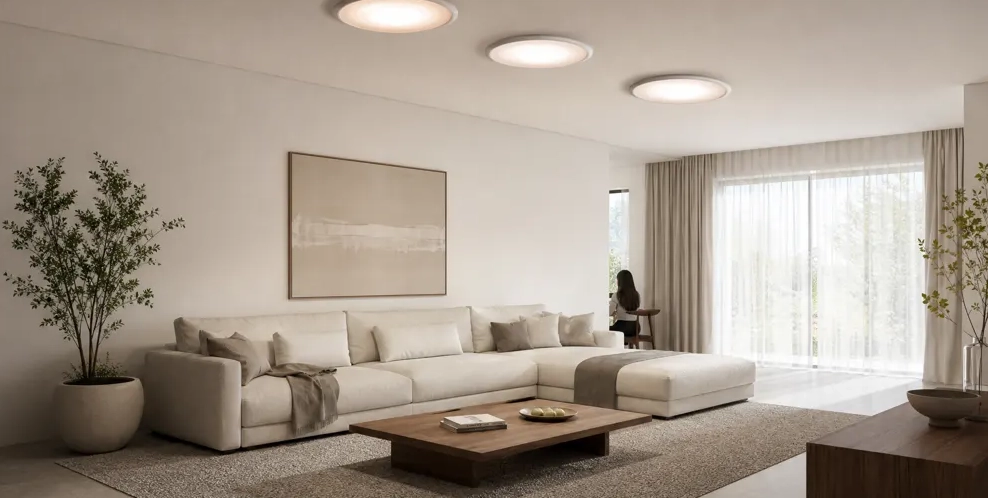
At 10 pm in a hotel guestroom, two 8 W downlights dimmed to 1900K hold the bedside near 8 lux melanopic EDI while the corridor outside still runs 4000 K at full output. Guests fall asleep behind a warm dim room; staff keep daylight-white task light one door away. That split — bright blue-rich days, low-blue nights — is what low blue indoor lighting means: cut the 460 to 495 nm band in the 3 hours before bed, keep colour true at Ra90, and leave narrow 590 nm amber to night lights only.
Why Evening Blue Costs Sleep
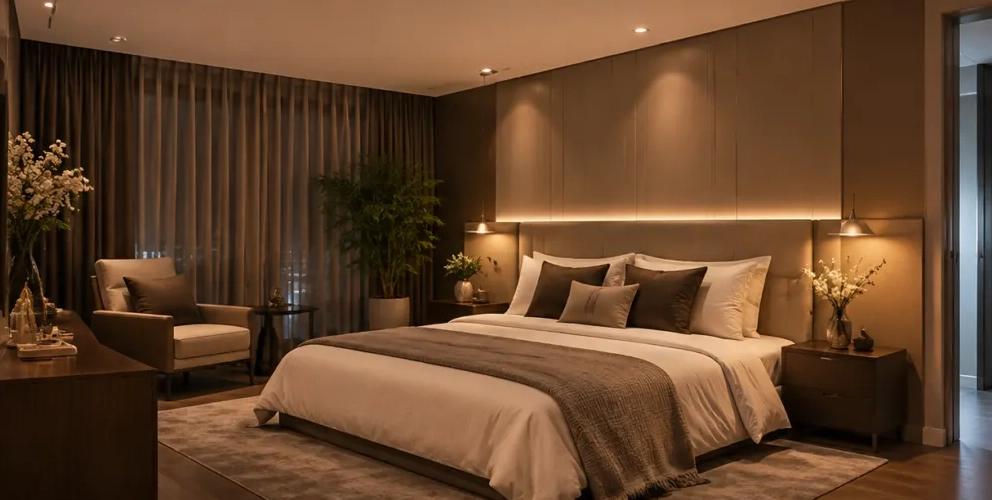
The eye carries melanopsin receptors peaking near 480 nm that report night and day straight to the circadian clock. Blue-enriched light in the evening suppresses melatonin, delays the clock and shortens deep sleep, while the same blue by day sharpens alertness — timing decides whether blue helps or harms. A 2023 consensus of 248 circadian scientists agreed evening 460 to 495 nm light disrupts sleep more than blue-depleted light at equal brightness, and home-lamp tests measured cool-white LEDs near 12.3 percent melatonin suppression against 3.6 percent for warm white and 0.1 percent for a tunable lamp parked at 2100K.
CCT Lies, Spectrum And Melanopic EDI Decide
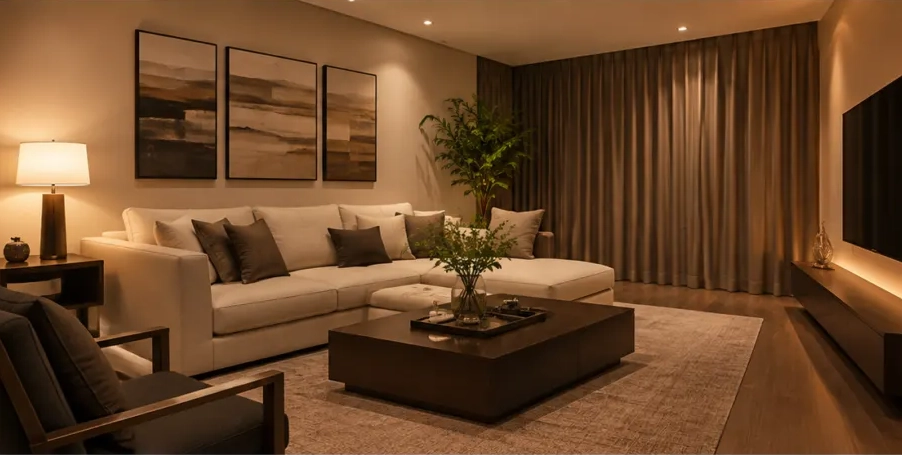
Two heads labelled 2700K can carry very different blue output, which is why the consensus ranks blue content above CCT for sleep outcomes. The practical metric is melanopic EDI at the eye: the expert recommendation holds days at or above 250 lux, evenings at or under 10 lux starting 3 hours before bed, and sleeping rooms at or under 1 lux. For how the dimming curve itself behaves over tables and bars, the dim to warm lighting guide for restaurants and hotels covers the two-curve mechanics this page builds on.
| Mode | Target at eye | Typical fitting |
|---|---|---|
| Day, work hours | Melanopic EDI at or above 250 lux | 4000K comfort downlight at full output |
| Evening, 3 h before bed | Melanopic EDI at or under 10 lux | 1800 to 3000K warm-dim Ra90, dimmed |
| Night, hallway trips | Melanopic EDI at or under 10 lux | Dim amber night light, narrow band fine |
| Sleeping room | Melanopic EDI at or under 1 lux | Off, blackout where street spills in |
How Much Blue Ordinary White LEDs Carry
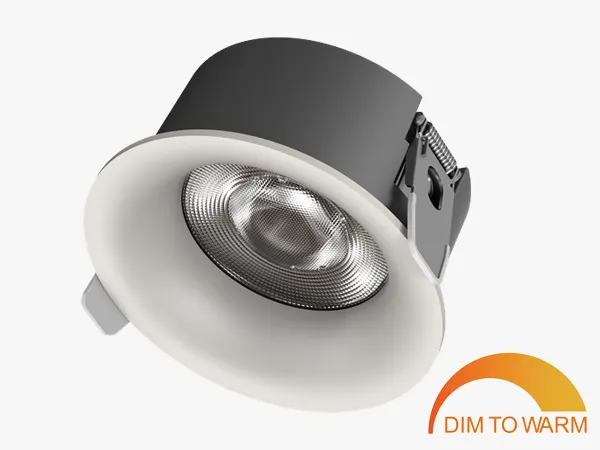
Every phosphor white LED starts as a blue chip near 440 to 460 nm, and the phosphor coating never converts all of that blue away. The finished SPD curve always keeps its blue pump peak, so blue content falls in a ladder: 4000K day heads carry the most, 3000K less, 2700K less again, and none of them reaches zero. A dim-to-warm head behaves differently from a fixed 2700K head because dimming drags the blue pump down together with brightness, parking near 2100K with almost no blue left, while a fixed-CCT head keeps its blue share at every dim level.
| Fitting | Blue pump left | Evening suppression, home-lamp tests | EDI slot |
|---|---|---|---|
| Cool-white 4000K day head | Highest of the indoor set, full pump peak | Near 12.3 percent | Day only, 250 lux and above |
| Warm white 2700 to 3000K | Medium, pump peak still visible | Near 3.6 percent | Evenings only if dimmed under 10 lux |
| Warm-dim low end near 2100K | Almost gone, pump dragged down with dimming | Near 0.1 percent | Evenings under 10 lux |
| Pure amber night light | Near zero, narrow 590 nm band | Negligible at dim levels | Night trips under 10 lux |
The reporting chain runs from the melanopsin receptors near 480 nm through the retinohypothalamic tract to the SCN clock, which then holds back pineal melatonin release. Three consequences follow when that chain fires in the evening: sleep onset slides later, deep sleep shortens, and the whole clock phase-delays into the next day. Four variables decide the dose at the eye: cooler CCT, higher lux, longer exposure, and closer timing to bedtime. Blue content matters more than the CCT label at equal brightness, which is why two heads printed 2700K can land on different sides of the 10 lux line.
Ask for the SPD curve and the melanopic EDI at the planned eye illuminance before ordering, then match the row to the room: 4000K for day circuits, warm-dim for evenings, pure amber only for the night path.
Room By Room: What Goes Where
Bedrooms and hotel guestrooms earn warm-dim first: a dim to warm downlight for hotels and restaurants running 1800 to 3000K at Ra90 keeps skin tones and bedding natural at the low end, where a narrow 590 nm amber head near CRI 20 to 50 would turn faces waxy. Living rooms follow the same curve for film nights, children's rooms add a hard off-time, and bathrooms and halls get the only pure-amber job in the house — a dim step light for night trips.
How To Buy Downlights That Prove It
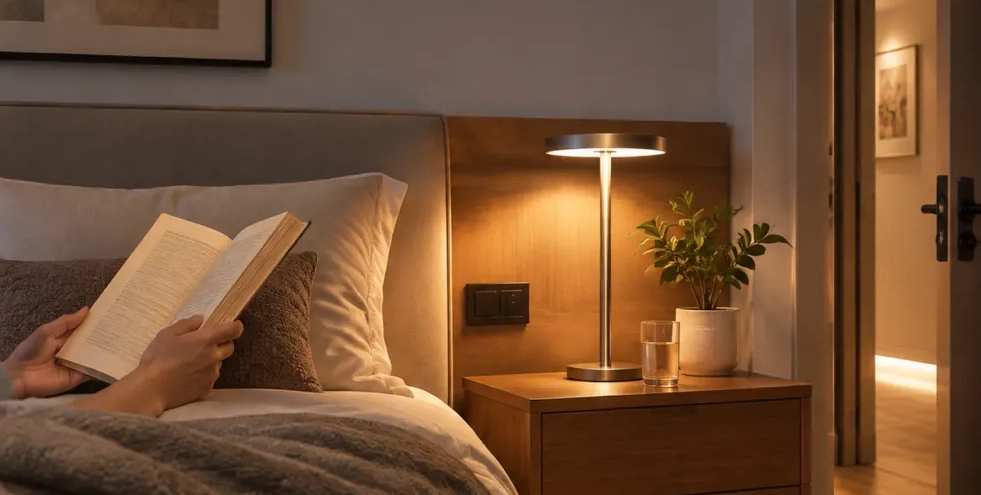
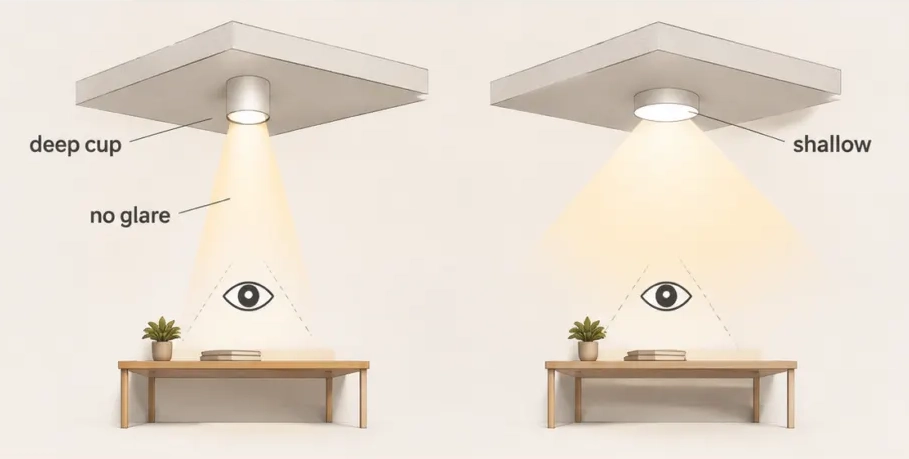
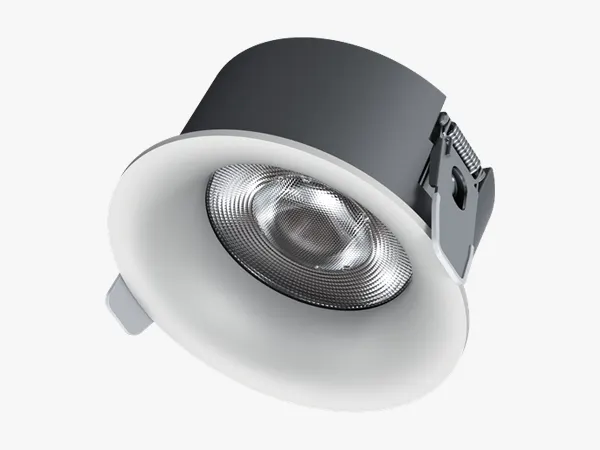
Start from a fixed comfort housing such as the recessed comfort downlight for hotels for daytime task light, then add the warm-dim version on the evening circuit. Demand the dimmer compatibility list by edge type, Pst LM at most 1.0 with SVM at most 0.4 on the driver sheet, and a 10 percent re-test before sign-off — the dimming technology choice guide compares wall, analog and bus dimming while this page sets the sleep targets each must hit. For restaurant tables that share the same heads, the warm dim track light for restaurants and bars runs the matching curves on rails.
FAQ
Conclusion
Light days bright, evenings warm and dim: 250 lux melanopic days, under 10 lux evenings, under 1 lux sleep, all at Ra90 except the hallway night light. Warm-dim downlights carry the evening, fixed comfort housings carry the day, and pure amber stays where it belongs — the night path. Browse the full industry guide index for the dimming and sensor companions, then send the room size and bedtime for a fitting count.
Evening light should carry as little blue as practical: dim the room or cut the blue content, because blue content decides sleep outcomes more than the CCT label.
Sources
- The 2023 circadian consensus of 248 researchers behind the evening blue and melanopic EDI targets above.
- The Brown et al. daytime, evening and nighttime light recommendations (250/10/1 lux) used for the three-mode table.
- The American Medical Association light pollution health report (PDF) on melatonin suppression and glare behind the bedroom advice.
WHY BUYERS WORK WITH LOW CARBON TECLUX
About Low Carbon Teclux
Low Carbon Teclux Co., Ltd. has manufactured LED commercial lighting since 2010. As a factory-direct OEM/ODM manufacturer, we serve importers and distributors across Europe and Australia — from product selection and sample testing to mass production and delivery, one team covers engineering, manufacturing and sales.
Our Engineering Support
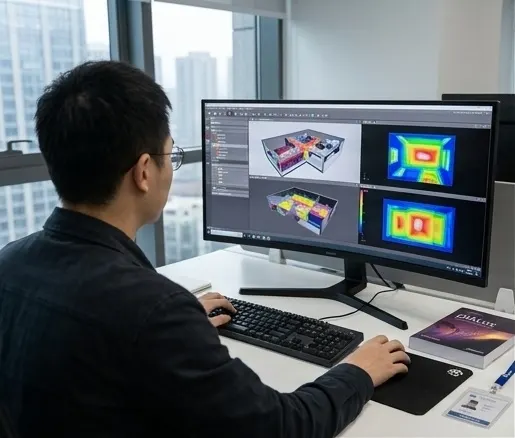
We help project buyers select the right fitting, optic and driver — not just compare prices. Send us your application, mounting height, target lux, dimming protocol and finish requirement, and our engineers will recommend a series, optic, driver basis and spare-parts plan for your RFQ. Where no standard fitting fits, we co-develop custom luminaires around your project — housing, optic, driver and finish engineered to your spec, from prototype to mass production.
REQUEST A QUOTECOMPANY PROFILE // DATA_SHEET
NAME
Low Carbon Teclux Co., Ltd.
BRAND NAME
Low-Carbon
BUSINESS TYPE
LED Lighting Manufacturer
SERVICE
Factory Direct / OEM / ODM
MAIN PRODUCTS
LED Track Lights, Linear Lights, Downlights, Outdoor Luminaires
CAPABILITY
Engineering, Manufacturing & Sales in One Team; Sample to Mass Production
CERTIFICATIONS
CE / FCC / RoHS / ISO9001
EXPORT REACH
Europe & Australia
Contents Table
Need Help Selecting the Right Luminaire?
Tell us your application, mounting height and target lux — our engineers will recommend a fitting, optic and driver configuration, or co-develop a custom fitting when no standard model fits.
REQUEST A QUOTESend Message
Fill out the form and we will get back to you as soon as possible