 John, Sales ManagerIndustry News
BLE Dimming Retrofit for Poultry Houses
If the layer house must hold 14 to 16 hours of steady light while the broiler house next door runs a step-down schedule, choose a BLE dimming retrofit for poultry houses that keeps 5 lux on the litter without pulling new signal wires. A tube stamped dimmable still failed one handover last season: it lit 30 lux on day one, then flickered at 5 lux in week three when the old wall dimmer met a new LED driver. The fix below is a wireless dimming retrofit without signal wires paired with a sealed tubular light for chicken houses, checked at five points: brood level, the legal floor, low-end flicker, seal, and what the mesh does when its gateway dies.
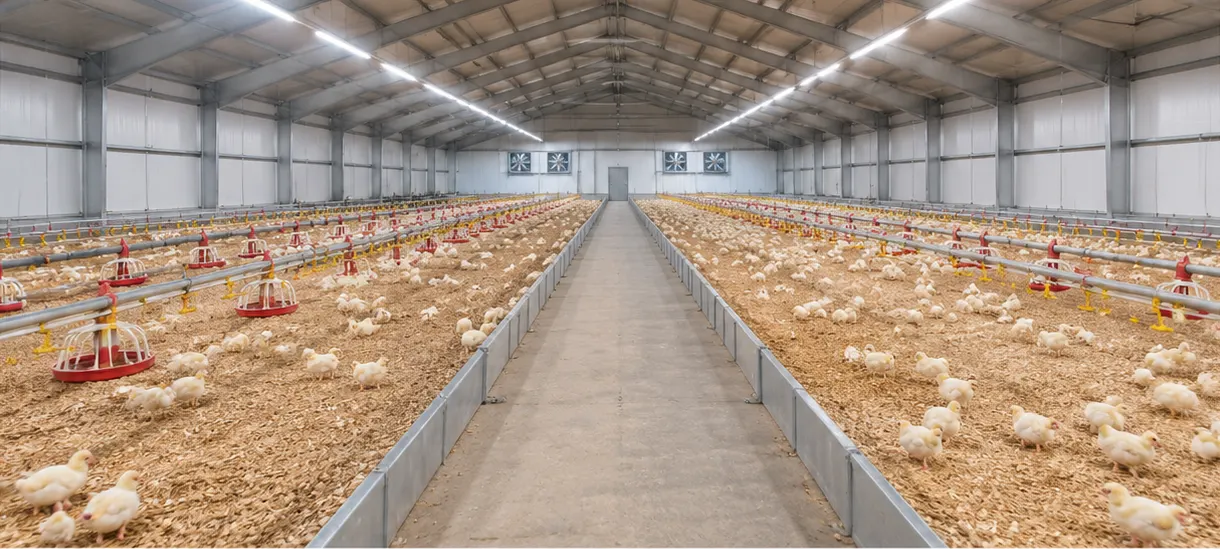
Brood to catch: the only levels that matter
Birds do not move between programs during a flock, so dimming precision means holding the right level at the right week, not re-aiming heads. The table below follows the University of Georgia brooding program for 42-day birds, with layer hold values beside it. Measure at bird level, and keep the spread within 20 percent from brightest to darkest point during brooding.
| Stage | Light : dark | Floor level |
|---|---|---|
| Brood day 0 to 4 | 23:1 down to 20:4 | 30 lux or higher |
| Grow day 7 onward | 20:4 down to 18:6 | 5 lux |
| Finish week 5 to catch | Back up to 22:2 | 5 lux |
| Layers in lay | 14 to 16 hours total | 30 lux at the trough |
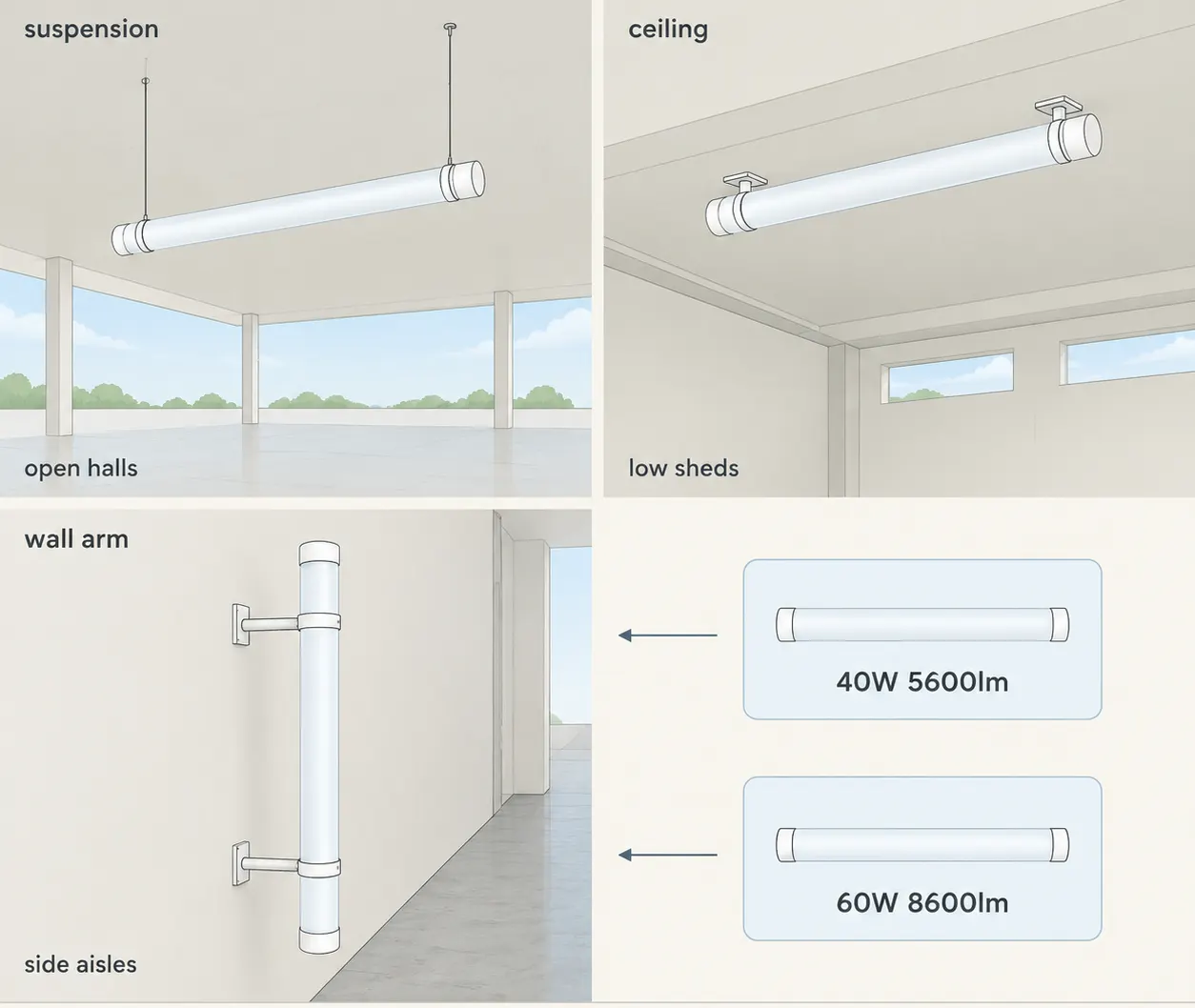
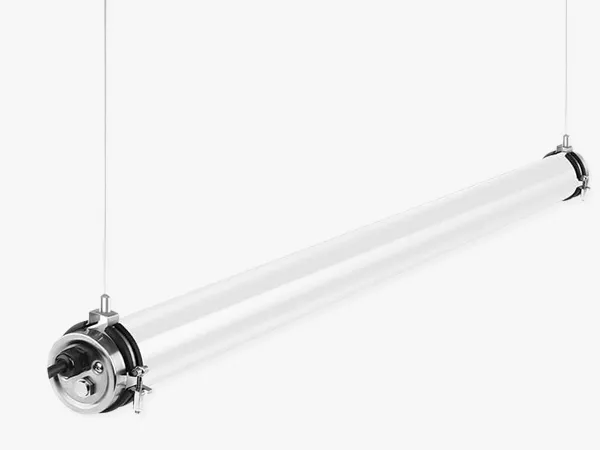
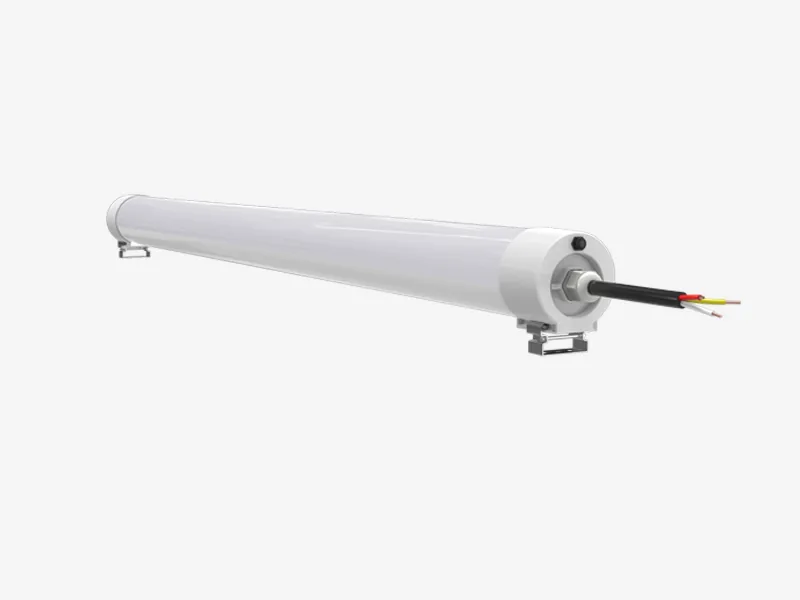
Two spectrum notes decide the lamp order, and neither is about mood. Broiler contracts usually specify 5000K cool white, while breeder and layer houses take 2700K to 3000K warm white for sexual maturity — Mississippi State puts both down to integrator preference rather than a welfare effect. The calmness growers report after swapping CFL for LED traces to flicker: the LED stops the mains strobing the birds can see, whatever its colour temperature. Confirm the kelvin with the integrator before ordering, because some contracts only accept listed lamps. The DURA-P tube in this guide ships 40W at 5600lm for tiers and 60W at 8600lm for 3 to 4 m broiler halls, both 140lm/W with a 120-degree frosted beam for floor-first cover.
Five lux is a US number, not a legal floor
That table is a US integrator programme, and its footnote gives the game away: Cobb's broiler guide drops to 5 to 10 lux after day 7 "unless local legislation prohibits this reduction". The EU prohibits it. Directive 2007/43/EC sets a floor of 20 lux during lighting periods, measured at bird eye level and covering at least 80 percent of the usable area. It also demands a 24-hour rhythm with six hours of darkness in total and one uninterrupted block of four hours, from day 7 until three days before slaughter — and dimming periods do not count as darkness, so a 30-minute fade-up eats into the six.
| Scheme | Grow-phase floor | Dark rule |
|---|---|---|
| EU broiler directive 2007/43/EC | 20 lux at bird eye level, over 80% of usable area | 6 hours total, 4 uninterrupted; ramps excluded |
| European Chicken Commitment | 50 lux through the day, natural light included | 6 hours total, 4 uninterrupted |
| US integrator programme | 5 to 10 lux after day 7; 25 lux in the darkest brood spot | Set by the integrator, usually 4 to 6 hours |
| Layer house in lay | 30 lux at the feed trough | 14 to 16 hours of light |
Ask which scheme the flock is audited against before the tube count is fixed. A house on a US integrator programme can run 5 lux and bank the feed conversion. A house audited under the directive cannot dim below 20 lux at bird level, and a retrofit handed over without that question answered leaves the buyer holding a non-conformance at the next audit.
The tube does not replace the brooder
An incandescent brood lamp was a heater with a filament problem; a 60W LED tube puts its watts into light and almost none into radiant heat. UGA starts brooding near 93°F (34°C) at floor level and expects the brooder to hold it, so swapping lamps changes the heat balance of the first week even when the lux grid reads correctly. Log floor temperature before and after the change, and keep brooder capacity out of the lighting budget.
Activity follows light, which cuts both ways. Rault et al. (2017) put broilers under 5 and 20 lux and found the 20 lux birds more active, slower growing and lighter-eyed, with more footpad dermatitis at 5 lux in one of the two replicates. Dimming to 5 lux is a production trade, not a free gain, and the litter tells you when the trade has gone too far.
Why old dimmers destroy new tubes
Mississippi State's P3380 names the mechanism better than any datasheet: a TRIAC dimmer chops the mains sine wave, the LED driver fights back to hold constant current, and the row ends up ghosting, losing half the dial to dead travel, dropping out at the bottom or dimming unevenly from head to head. Three habits make it worse — mixing brands or wattages on one dimmer, leaving corroded keyless sockets in place, and running the dimmer on a shared neutral. The same publication asks for nickel-brass sockets and a neutral taken straight from the panel. Where the dimmer is replaced rather than reused, MSU's lighting tips pair LED lamps only with trailing-edge models, which switch at the zero crossing and suit capacitive drivers.
Before signing any retrofit, count heads-per-breaker with inrush Ipk and T50 so the new inrush does not trip the old breaker on the first night.
- Ghosting — lamps never fully extinguish because the dimmer leaks current at zero.
- Dead travel — half the dial rotation changes nothing visible at the floor.
- Drop-out — lamps cut out completely while dimming down through 5 lux.
- Pop-on — lamps jump to full output when raised from parked position.
Flicker chickens see and humans miss
Chickens resolve flicker well above the human limit, so a driver that looks steady to the stockman can still stress the flock. Behavioural work puts conscious fusion near 90 to 105 Hz, while retinal responses reach 119 Hz — Lisney et al. (2012) measured the retinal figure with electroretinograms in hens — which makes 100 Hz magnetic-ballast flicker visible to birds. In the Saskatchewan layer work, pullets reared at 30 Hz died more than the 250 Hz group; turkey hens at 30 Hz grew slower to 8 weeks and died more than the 195 Hz group; turkey toms showed no difference at 165, 500 or 16,000 Hz (Raabe et al., 2024). That is where the 165 Hz bar comes from: the lowest frequency with a clean turkey result, not a welfare ceiling. Specify the low-end check in writing: stable output at 5 lux with no visible strobing, verified with a phone slow-motion pass before handover, and put the 50,000-hour line on the datasheet through its LM-80 test hours before tender.
| Frequency | Bird response | Spec consequence |
|---|---|---|
| 30 Hz | Clearly visible; higher mortality in layer pullets and turkey hens | Reject any driver showing this band at low end |
| 100 to 120 Hz | Visible to hens, activity change in broilers | Mains-chopped dimming needs proof, not trust |
| 165 Hz and above | No signal in turkey toms at 165 Hz; hen houses clean at 195 Hz | Minimum bar; specify 195 Hz or above for layers and breeders |
No-wire retrofit against wired control
New sheds with an environmental computer keep wired control, because light, feed and ventilation share one screen. Live-house retrofits pick wireless, because no control cable means no shutdown and no trenching. Schedules can live in the mesh and run without a phone in hand, provided something keeps time and the failure case below is settled before handover.
| Path | Wiring | Low end | Best fit |
|---|---|---|---|
| 0-10V to farm controller | Two extra wires per zone | About 10 percent, then snap or flicker | New sheds, one level per zone |
| DALI DT6 addressed | Two-wire bus, 64 addresses | Down to 0.1 percent logarithmic fade | Audit jobs needing per-point proof |
| BLE mesh scenes | Mains only, no signal cable | Driver-dependent, demand 1 percent steady | Live-house retrofit, brood-grow-catch scenes |
What the mesh must survive
Bluetooth mesh carries Scene, Scheduler and Time models in the specification, so a schedule can live in the fittings rather than in a phone. It still needs a time source, and on most farms that is the gateway. Settle four failure cases in writing before the purchase order.
- Gateway down — scenes must still recall from the wall panel, and a running schedule must keep its place instead of freezing at the last level.
- Power cut — nodes rejoin in a defined order and return to a defined level, not to full output at 2 a.m.
- Radio — steel cladding, feed bins and variable-speed fan drives all share the 2.4 GHz band. Walk-test the empty house first, then repeat it with birds and equipment running, and size relay density from that test.
- Commissioning — ask for minutes per node, then multiply by lamp count. A 1,000-lamp house is small against the 32,767-node mesh limit; the real cost is the person with the tablet.
Standby power belongs in the same conversation. A radio idling at half a watt is 500 W continuous across 1,000 lamps, real money against a row of 40W tubes. The bulk commissioning guide covers the provisioning mechanics; this page only asks what a poultry house does to them.
From circuit check to signed acceptance
Retrofits fail at handover more often than at installation. Run the job in this order, and each step leaves a record the next one can be checked against.
- Count heads per circuit and note the inrush, so the first night does not trip a breaker.
- Draw the zone map: brood, grow, catch, plus any layer house that keeps its own programme.
- Meter the existing grid at bird level, including the dark corners nobody has measured since the house was built.
- Fix gateway position and relay density on the empty-house walk test, then repeat it with equipment running.
- Provision in zone order, label every node and keep the address list with the as-built drawings.
- Run the failover drill before the birds arrive: unplug the gateway, cycle the mains, watch what the rows do.
- Accept at three levels with a calibrated meter, and file one signed sheet per house.
| Gate | Target | Evidence |
|---|---|---|
| Brood | 30 lux at bird level, 25 lux in the darkest corner | Meter grid on litter |
| Grow | 5 lux on a US programme, 20 lux under the EU directive | Same grid after 30 minutes warm-up |
| Uniformity | Within 20 percent, brightest to darkest | Same grid, one sheet per house |
| Low end | No visible strobing at 5 lux; driver 165 Hz or higher | 240 fps slow-motion clip at the darkest point |
| Seal | IP65 on the complete fitting, gland and end caps included | Certificate plus gland torque check |
| Failover | Scenes hold with the gateway unplugged; schedule resumes after a mains cycle | Ten-minute drill, recorded |
Seal audit before purchase order
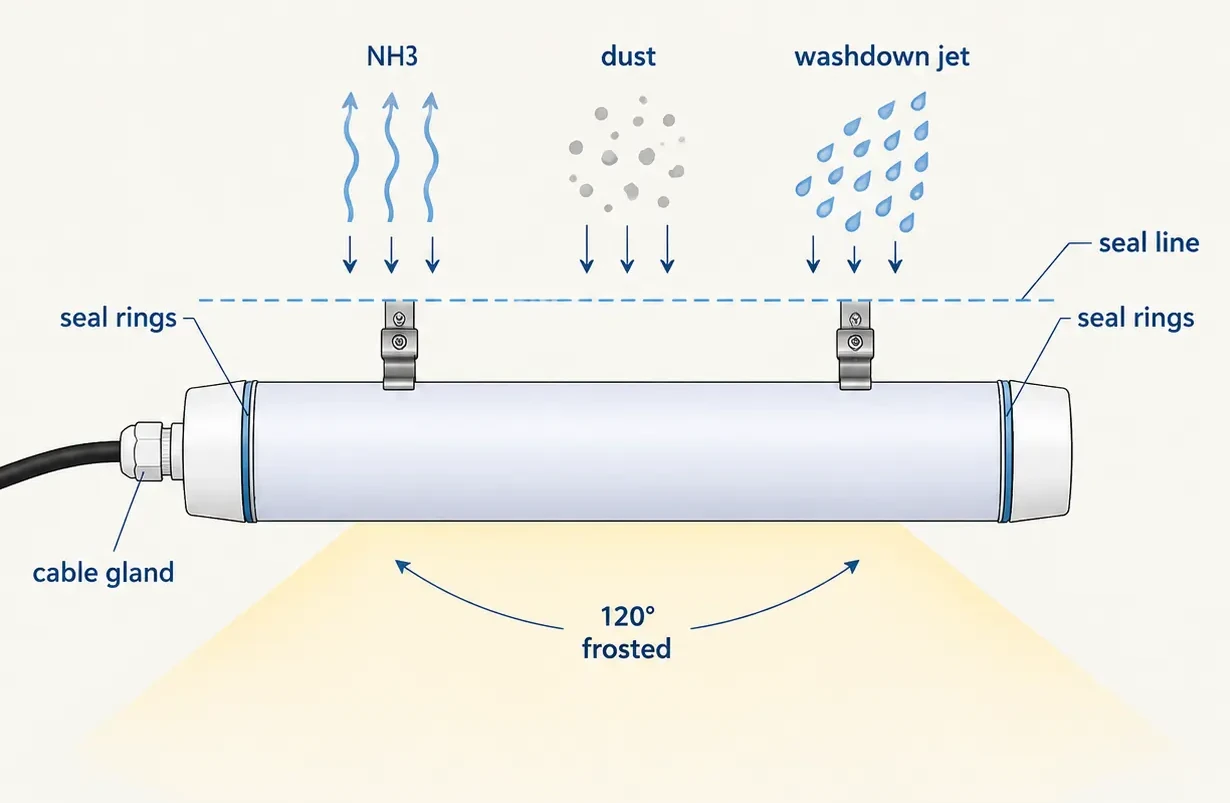
IP65 certifies dust-tightness and water jets under IEC 60529: a 6.3 mm nozzle at 12.5 litres per minute from three metres. That is hose-down, not a pressure washer. A 100-bar lance at 80°C is IPX9K territory under ISO 20653, so either keep the lance off the tube or specify the higher rating; a fitting sold as pressure-wash safe on IP65 alone is a warranty argument waiting to happen.
IP65 also says nothing about ammonia. Gas reaches driver boards through gaskets and glands during thermal cycling, then copper corrodes and lenses haze. No harmonised ammonia rating exists for luminaires — IEC 60068-2-60 is a mixed-gas test for SO2, NO2, H2S and Cl2, not NH3 — so ask for the report behind the claim: ppm, temperature, humidity, hours, whole fitting or bare board, and whether the driver compartment is sealed from house air. The EU caps ammonia at 20 ppm at bird head height in its broiler rules, which is a fair number to test against. Run every candidate through five lines: full-assembly IP65 or better including glands and end caps, silicone gaskets instead of foam tape, stainless clips and hardware, a driver compartment isolated from house air, and washdown references from houses at comparable stocking density. Add a sixth for the cleaning crew: alkaline foam and quaternary ammonium disinfectants attack polycarbonate, so ask which cleaner the cover was tested with before "wipes clean" goes into the tender. Higher CRI does not mean lower efficacy here, since the specified tube holds CRI 80 with 140lm/W while the house program does the rest.
What to ask the supplier
- Which welfare scheme the flock is audited against: the EU directive, a retailer scheme or an integrator programme.
- Which environmental computers and gateways pair with the BLE scenes, who commissions them, and the minutes per node.
- Which old TRIAC models the driver has been tested against, with the low-end lux on record.
- Measured flicker at 5 lux and the meter or slow-motion method behind the number.
- What happens when the gateway fails: do scenes hold, does the schedule survive a power cut, and who holds the admin account and firmware.
- Ammonia test conditions with the report attached, not a line on a brochure.
- Washdown rating with pressure, nozzle size and distance stated, IP65 or IPX9K.
- Warranty wording for agricultural use, washdown and dimming included or excluded, plus spare driver and end-cap lead time for a 1,000-piece house.
FAQ
Conclusion
Set the programme first, the jurisdiction second and the protocol third. Brood at 30 lux, grow at 5 lux where the integrator allows it or 20 lux under the directive, and let the seal and the failover drill decide the rest. For live houses without spare shutdown windows, a BLE mesh scene set over a sealed tube row is the shortest path from flickering TRIAC rows to a house that holds 5 lux through catch week. Send house length, mounting height, the welfare scheme the flock is audited against and the controller model for a tube count and a dimming compatibility check.
"The relationship between LED lamps and TRIAC dimmers is problematic at best... All aspects of the system must work together to be successful — the wiring, the dimmer, the controller, the lamps, and the sockets."
Sources
- University of Georgia Extension, Five Common Issues During Brooding, Poultry Tips 2017.
- Mississippi State University Extension, Why Poultry Growers Have Issues Dimming LED Lamps, publication P3380.
- Council Directive 2007/43/EC on the protection of chickens kept for meat production, EUR-Lex consolidated text.
WHY BUYERS WORK WITH LOW CARBON TECLUX
About Low Carbon Teclux
Low Carbon Teclux Co., Ltd. has manufactured LED commercial lighting since 2010. As a factory-direct OEM/ODM manufacturer, we serve importers and distributors across Europe and Australia — from product selection and sample testing to mass production and delivery, one team covers engineering, manufacturing and sales.
Our Engineering Support
We help project buyers select the right fitting, optic and driver — not just compare prices. Send us your application, mounting height, target lux, dimming protocol and finish requirement, and our engineers will recommend a series, optic, driver basis and spare-parts plan for your RFQ. Where no standard fitting fits, we co-develop custom luminaires around your project — housing, optic, driver and finish engineered to your spec, from prototype to mass production.
REQUEST A QUOTECOMPANY PROFILE // DATA_SHEET
NAME
Low Carbon Teclux Co., Ltd.
BRAND NAME
Low-Carbon
BUSINESS TYPE
LED Lighting Manufacturer
SERVICE
Factory Direct / OEM / ODM
MAIN PRODUCTS
LED Track Lights, Linear Lights, Downlights, Outdoor Luminaires
CAPABILITY
Engineering, Manufacturing & Sales in One Team; Sample to Mass Production
CERTIFICATIONS
CE / FCC / RoHS / ISO9001
EXPORT REACH
Europe & Australia
Contents Table
Related Product
Need Help Selecting the Right Luminaire?
Tell us your application, mounting height and target lux — our engineers will recommend a fitting, optic and driver configuration, or co-develop a custom fitting when no standard model fits.
REQUEST A QUOTESend Message
Fill out the form and we will get back to you as soon as possible