 John, Sales ManagerIndustry News
Does a Luminaire Need EPREL Registration? The EU Compliance Check
Introduction
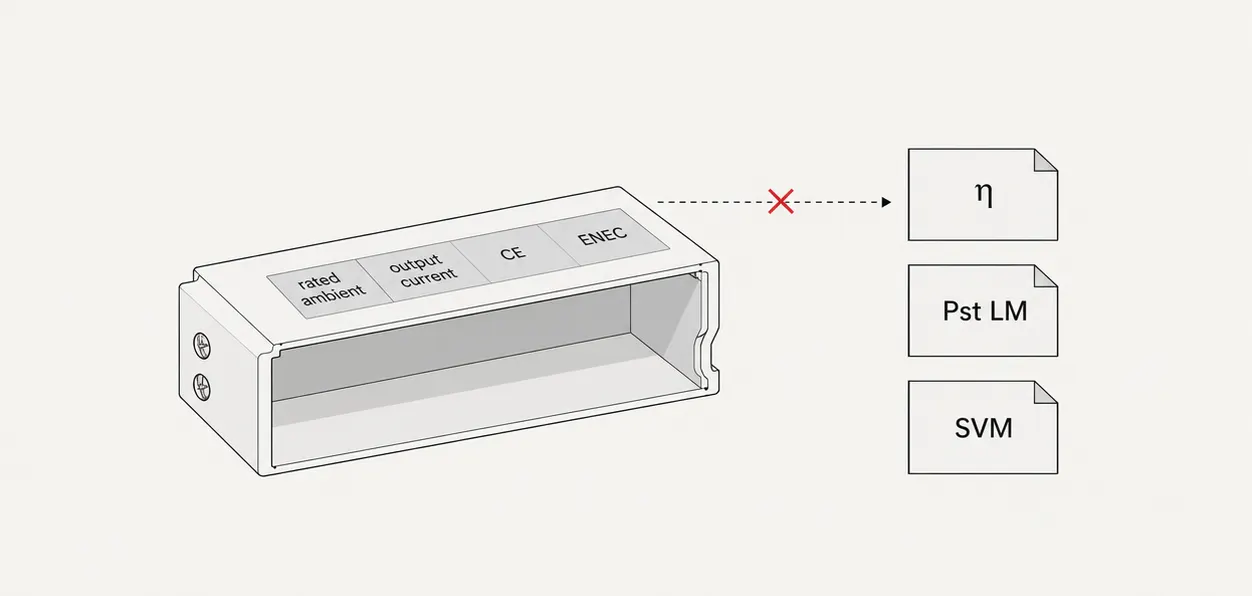
When a buyer asks whether a luminaire can be sold in the EU, the answer "CE certified" covers less than the question. A luminaire has carried no EU energy label since 25 December 2019, and a luminaire is normally not registered in the European Product Registry for Energy Labelling (EPREL) either; the light source inside it is. When that light source cannot be removed without permanent damage, the entire fitting is treated as a light source and takes the label, the database record and the efficiency test with it.
This guide turns that distinction into a purchasing decision: the three product cases and the documents each one needs, the power formula behind the ecodesign threshold, the flicker limits with the September 2024 change that many datasheets still ignore, and a ten-minute supplier check. The examples come from the commercial LED luminaire range, where a 30 W track head with the driver inside the adapter and a 30 W module fed by a remote driver carry different obligations.
Three Product Cases, One Triage Table
The regulation classifies products with a single question: can the light source be taken out for verification without being permanently damaged? Damage to the housing does not count; damage to the light source does. A glued or potted LED module cannot come out, so the fitting is the light source. A module fixed with screws and a plug-in connector can, so the fitting only contains a light source.
| What is on the pallet | Light source? | EPREL record | Energy label | Ecodesign limits |
|---|---|---|---|---|
| Sealed fitting, LED module potted or glued in | Yes, the whole fitting | Required for the fitting | Required on the packaging | Power, flicker and endurance apply in full |
| Fitting with a tool-removable module or lamp | No, a containing product | Not for the fitting; the contained source needs its own | Not required | Apply to the contained source |
| Housing with no source, or an exempt application | Out of scope | None | None | None |
Scope has three more conditions. The product must emit white light, deliver between 60 and 82,000 lumens, and carry a colour rendering index above zero. Fittings for explosive atmospheres, emergency use, medical devices, battery-powered products and bicycles are outside the regulation entirely, and emergency luminaires stay outside only when the light source is specifically tested and approved for emergency operation.
A common shortcut states that luminaires are out of scope. That holds for a fitting with a replaceable module and fails for a sealed one, and the two can share a housing, a diffuser and a carton. Ask the supplier which row of the table the product occupies, and require that answer in writing on the quotation.
What "Removable Without Permanent Damage" Means
According to the European Commission guidance on light sources and containing products, the light source must survive the removal intact; the surrounding luminaire may be damaged in the process without changing the classification. Potting compound, thermal adhesive and riveted optics therefore turn a luminaire into a light source, while two screws and a plug keep it a containing product.
Containing products carry four duties of their own, and none of them is a label. Light sources and control gear must be replaceable with commonly available tools without permanent damage to the fitting, or the technical documentation must explain why replacement is inappropriate. The same parts must be removable for market surveillance, with instructions in the technical file. Replaceability has to be published on a free-access website, and consumer products add a pictogram on the packaging and in the user instructions. At end of life, both parts must come out for dismantling.

The practical consequence is that two visually identical fittings can land on opposite sides of the line, and the drawing decides which. Request the removal instruction page with the quotation; when no such page exists, the product is a light source and the full test set applies.
The Formula That Decides Pass Or Fail
The ecodesign threshold is not a flat 120 lm/W, although 120 lm/W is the number most quotations quote. The regulation caps on-mode power against a maximum that depends on flux, beam type, colour rendering and control gear type, so the same 100 lm/W product can pass in one category and fail in another.
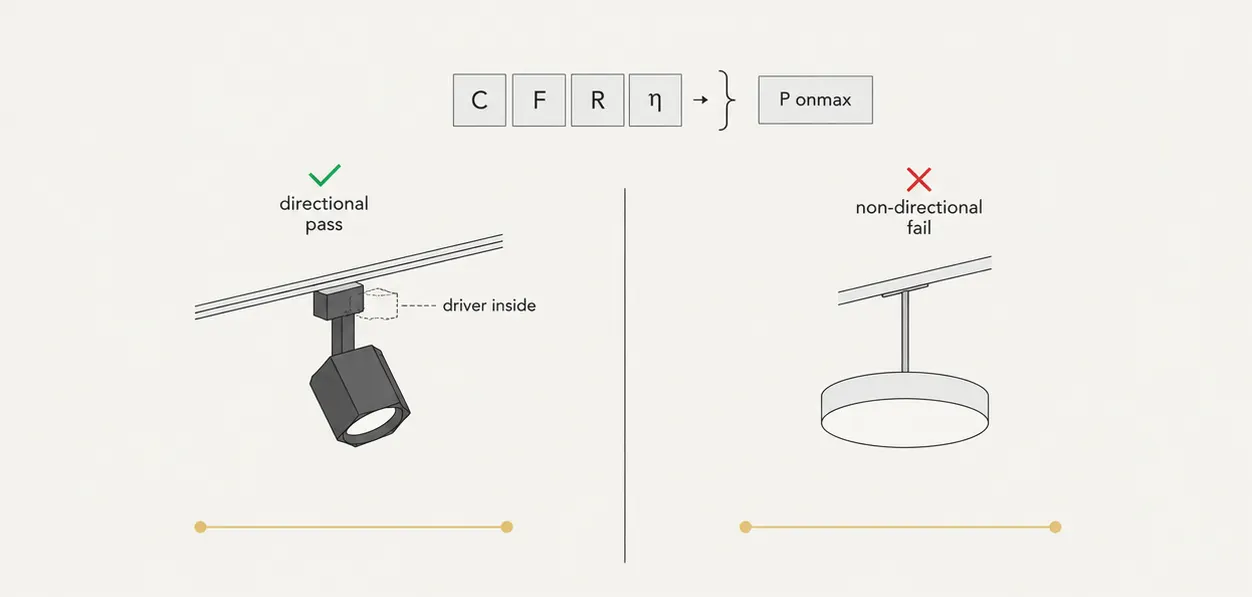
Pon ≤ Ponmax = C × (L + Φuse / (F × η)) × R
| Factor | Value | Depends on | Effect on the cap |
|---|---|---|---|
| η and L | 120 lm/W and 1.5 W | Light sources not listed elsewhere, which covers LED | Sets the baseline cap |
| F | 1.00 or 0.85 | Non-directional or directional flux | A spot may use 15 percent less flux in the sum |
| R | (CRI + 80) / 160 | Declared CRI, two decimals | CRI 80 gives 1.00, CRI 90 gives 1.06 |
| C | 1.000 / 0.926 / 1.176 / 1.089 | Directional or not, mains or not | A directional mains source gets the largest allowance |
Run the numbers on two products with identical output. A 3,000 lm directional mains track head at CRI 90 uses C = 1.176, F = 0.85 and R = 1.06, which allows 38.5 W; a 30 W head at 100 lm/W passes with room to spare. A 3,000 lm non-directional mains lamp at CRI 80 uses C = 1.000, F = 1.00 and R = 1.00, which allows 26.5 W; the same 100 lm/W fails, because 3,000 lm at 26.5 W needs 113 lm/W.
That gap explains why efficacy figures cannot be compared across categories, and why a track head can carry a warm 3000 K, CRI 90 engine and still clear the threshold. The September 2023 step of the regulation tightened only linear fluorescent T8 tubes and ended the G9, G4 and GY6.35 halogen classes; the 120 lm/W threshold for LED light sources did not move. Ask for the calculated Ponmax beside the efficacy figure, not instead of it.
Flicker: Two Numbers And A Date
Two metrics replace the word "flicker-free" in law. Pst LM covers visible flicker between 0.3 Hz and 80 Hz, and the stroboscopic effect visibility measure (SVM) covers the 80 Hz to 2,000 Hz band where a moving object appears to jump or stop. Both are measured at full load.
| Placed on the market | Pst LM | SVM | What a buyer should accept in 2026 |
|---|---|---|---|
| Before 1 September 2021 | No limit | No limit | Nothing; ask for measured data |
| 1 September 2021 to 31 August 2024 | ≤ 1.0 | ≤ 0.9 | A 0.9 report is valid for its date, not for a new order |
| From 1 September 2024 | ≤ 1.0 | ≤ 0.4 | 0.4 or lower, measured on the shipped driver |
The 0.9 figure came from Commission Regulation (EU) 2021/341, which relaxed the original 0.4 for three years and restored it on 1 September 2024. A datasheet still quoting 0.9 in 2026 therefore describes a 2021 product or an unrevised template, and either reading is a reason to ask for the report and its date.
One tolerance matters more than the limit itself. Market surveillance may measure up to 0.1 above the declared value before calling a model non-compliant, so a supplier who declares exactly 0.4 can legally deliver 0.5. A declared value sitting on the limit is a declaration strategy, not a measurement, and the only way past it is the laboratory report with the driver model printed on it.
"Flicker-free" has no definition in EU law. The defined terms are Pst LM and SVM, and a catalogue using the marketing phrase without either number has told the buyer nothing that can be enforced in a purchase order.
Where The Flicker Rule Stops
Four boundaries decide whether the limits bind a given fitting, and buyers who skip them end up enforcing a clause that never applied.
- The clause targets mains light sources. LED and OLED MLS means a source that runs on mains voltage. A 24 V or 36 V module fed by separate control gear is not an MLS, so the combination is outside the flicker limits; the driver is separate control gear and answers its own efficiency and standby requirements.
- Full load only. Neither metric is required at 10 percent or 1 percent output, which is exactly where pulse-width dimming produces its worst waveform.
- Outdoor and industrial exceptions. Light sources for outdoor or industrial use, or for applications where lighting standards allow CRI below 80, are exempt from the SVM limit even though the Pst LM limit still applies.
- Camera work is a private spec. Film and broadcast crews work to SVM ≤ 0.1, which is an industry expectation rather than a legal limit, and a studio or showroom lighting a video wall should write that number into the order.
The dimming method explains most complaints. Pulse-width modulation switches the LED fully on and off at high frequency, so modulation depth stays near 100 percent however low the average output; constant-current reduction lowers the current and holds the waveform flat. A track head with the driver inside the adapter, such as the TRIAC dimmable track head with its driver in the adapter, can be tested as a complete mains source, while a remote-driver build has to be specified by the buyer.

Write the numbers into the purchase order instead: Pst LM at full load, SVM at full load, and both values again at 10 percent output if the project dims. A supplier who cannot measure the dimmed condition can still declare the dimming method, and that declaration is checkable on site.
What The Database Actually Says
An EPREL number proves that a form was filled, not that a product was measured. The International Energy Agency's 4E platform compared the reported values in EPREL with laboratory tests of 580 lamps bought in Europe and Australia, and the gap is the most useful warning in the file.
- 520,084 LED products sat in EPREL at the May 2025 snapshot, 499,251 of them still on the market; 274,501 models carried a Pst LM value and 257,710 carried an SVM value.
- 48 percent reported Pst LM of exactly 1.0, the maximum allowed, which the report reads as a default entry rather than a measurement.
- 1.7 percent reported Pst LM above 1.0 and 6.6 percent reported SVM above 0.9, both of which are non-compliant unless the model is exempt.
- 135 of the 580 tested lamps exceeded SVM 0.9 in the laboratory, several times the share that admits it in the database.
- The average reported SVM fell from about 0.35 to below 0.25 after the limit dropped in September 2024, which shows how closely the reported number follows the rule rather than the hardware.
Read the record as a starting point. The product information sheet carries the useful fields — CRI, R9, survival factor, lumen maintenance factor and both flicker metrics — and a value sitting exactly on a limit is the signal to ask for the report behind it.
Ten Minutes To Check A Supplier
Five checks cover most of the risk, and all five can run before a sample is shipped.
- Ask for the EPREL number or the exact model identifier. Open the product information sheet and read CRI, R9, survival factor, lumen maintenance factor, Pst LM and SVM from the record itself.
- Compare the two flicker fields with the limits for the date. A 2025 model at 0.9 SVM is not compliant, and a 2023 model at 0.9 was.
- Demand the laboratory report when a value sits on the limit. Check the report date, the laboratory, the driver model and the sample photographs against the product being quoted.
- Match the report to the bill of materials. A driver substitution after sampling leaves a valid report describing a product that is no longer shipped, and the substitution is the most common gap in the file.
- Read the manual sentence. A containing product must state "This product contains a light source of energy efficiency class X" with the correct class, and a sealed fitting must show the label and a registration that appears in the public database.
Since October 2024 the supplier identity behind a record is verified before registration, and models registered by unverified suppliers do not appear in the public search. A registration number that returns nothing is therefore a finding, not a website error.
Five Documents, One Folder
A complete file for one luminaire model holds five items. Any missing item is a question to answer before the container leaves, because none of them can be produced retroactively without the original sample.
- EPREL registration and product information sheet — proves the model is in the database, and carries the declared CRI, flicker and maintenance values.
- Ecodesign test report — proves the power, endurance and flicker results on a named sample with a named driver.
- Declaration of conformity — CE marking covers the ecodesign requirements through Directive 2009/125/EC; the label and the database record sit under the separate Energy Labelling Regulation.
- Manual page — carries the containing-product sentence and the replaceability statement, or the label artwork for a sealed fitting sold directly to end users.
- Technical file extract — holds the removal instructions for market surveillance and the justification when a part is deliberately not replaceable.
Product-level compliance is only half of a European project file. Building regulations such as the EPBD requirements for warehouses and commercial buildings sit on top of it, and the lifetime figure declared here is the one the endurance test has to support, so a supplier who quotes 100,000 hours still owes the measured hours behind it.
FAQ
- Potted, glued or riveted module: register the whole fitting, label the packaging, meet the power and flicker limits.
- Screwed module or plug-in lamp: no record for the fitting, a record for the source, plus the manual sentence and the removal instructions.
- The declaration of conformity lists 2009/125/EC and the lighting regulation.
- A registration number exists and resolves in the public database.
- The packaging carries the label when the fitting is itself a light source.
- Model first placed on the market before 1 September 2024: a 0.9 report matches the rule of its time.
- Model placed on the market from 1 September 2024: 0.4 is the ceiling, and 0.9 is a non-compliance.
- Outdoor, industrial and low-CRI applications: the SVM limit does not apply at all.
- The technical file must show the tests behind the emergency claim.
- The packaging and product information must state the intended use and that the product is not for general lighting.
- A maintained luminaire used for both normal and emergency duty needs the classification checked part by part.
Conclusion
The EPREL question is really a product-identity question, and it is answered by the drawing rather than the catalogue. Once the fitting is classified, three numbers carry the rest of the file: the calculated Ponmax against the measured power, the two flicker metrics read against the date the model entered the market, and the declared L70 that the endurance test has to support. A buyer who checks those three, plus the manual sentence and the removal instructions, has covered what market surveillance checks first.
Where the light source cannot be removed from the containing product without being permanently damaged, the entire product is treated as a light source, including its registration in the product database and its EU energy label.
Sources
- European Union, Commission Regulation (EU) 2019/2020 on ecodesign requirements for light sources and separate control gears (consolidated 2021) — scope, the Ponmax formula, the flicker limits and the removal duties.
- European Commission, Is my product a light source or a containing product? (2024) — the removability test and the split of obligations.
- IEA 4E SSLC Platform, LED Lighting Performance Analysis: Temporal Light Modulation 2014-2025 (2026) — reported EPREL values against 580 laboratory-tested lamps.
WHY BUYERS WORK WITH LOW CARBON TECLUX
About Low Carbon Teclux
Low Carbon Teclux Co., Ltd. has manufactured LED commercial lighting since 2010. As a factory-direct OEM/ODM manufacturer, we serve importers and distributors across Europe and Australia — from product selection and sample testing to mass production and delivery, one team covers engineering, manufacturing and sales.
Our Engineering Support
We help project buyers select the right fitting, optic and driver — not just compare prices. Send us your application, mounting height, target lux, dimming protocol and finish requirement, and our engineers will recommend a series, optic, driver basis and spare-parts plan for your RFQ. Where no standard fitting fits, we co-develop custom luminaires around your project — housing, optic, driver and finish engineered to your spec, from prototype to mass production.
REQUEST A QUOTECOMPANY PROFILE // DATA_SHEET
NAME
Low Carbon Teclux Co., Ltd.
BRAND NAME
Low-Carbon
BUSINESS TYPE
LED Lighting Manufacturer
SERVICE
Factory Direct / OEM / ODM
MAIN PRODUCTS
LED Track Lights, Linear Lights, Downlights, Outdoor Luminaires
CAPABILITY
Engineering, Manufacturing & Sales in One Team; Sample to Mass Production
CERTIFICATIONS
CE / FCC / RoHS / ISO9001
EXPORT REACH
Europe & Australia
Contents Table
Need Help Selecting the Right Luminaire?
Tell us your application, mounting height and target lux — our engineers will recommend a fitting, optic and driver configuration, or co-develop a custom fitting when no standard model fits.
REQUEST A QUOTESend Message
Fill out the form and we will get back to you as soon as possible